





A CTO at a big American shipping company ran into trouble lately, one that's showing up way too often. His crew burned through half a million bucks creating a smart algorithm to improve how items move inside storage centers. Sure, the math behind it looked solid on paper, but months later it just sat there, unusable by the legacy warehouse management system. Why? Because the ML development company they hired was focused only on algorithms. The code itself worked fine; the real issue was choosing a vendor who did not take care of enterprise integration. Here’s what really matters: nailing the science isn’t the challenge; getting it to work daily across teams and tools is. That’s where most efforts crash.
The True Problem with AI/ML Adoption
While plenty of top-level executives are hunting for a solid ai ml development company to boost performance, they run into a real roadblock when it comes time to deploy. Sure, there’s no shortage of tech providers ready to build fancy algorithms; however, study after study reveals 70% to 85% of artificial intelligence and machine learning projects never make it past testing. These efforts turn into unused smart; expensive tools stuck on the sidelines instead of powering daily operations.
This issue isn’t about lacking tech skills; it’s about poor strategy. Falling behind in AI means losing ground fast: companies slow to adapt would miss huge efficiency wins, like slashing operating costs by nearly half. On top of that, botched projects don’t just burn cash; they delay launches, waste effort, and kill faith in future tech pushes. While picking up an ai/ml development company, focus on enterprise integration expertise. It’s not a tool you’re after. Think bigger, when you're investing in something that must grow and make money.
Gartner says firms using AI well could boost efficiency by 30% before 2026. That figure shows how crucial it is to nail your AI setup from the start.
1. Strategy and Business Alignment: Beyond the Algorithm
The best ML development company isn’t about writing software first; it’s about understanding money flow. What you really want is someone who turns real problems, keeps customers from leaving or boosting factory output, into smart, doable tech goals.
Question 1: How do you define the success metrics and ROI before writing any code?
A supplier needs to show a clear path from tech results, say hitting 95% model precision to real business impact, like cutting false fraud alarms by 15%, which could save half a million bucks each year. Instead of just proving performance, they’ve got to explain how their tool fits within your broader move toward digital upgrades. That way, you’re certain the machine learning development company isn’t simply running experiments but actually creating something that boosts bottom line value.
Question 2: What is your process for integrating the solution with our legacy systems (CRM, ERP, etc.)?
This is where things fall apart. When the fix doesn't interact with current enterprise platforms, it just won’t work. You need to push for real cases of how API integration strategies work and how info stays synced across sources, while also checking their take on keeping data clean and under control. Zero in on solid API integration best practices that support smooth back and forth movement essential for constantly upgrading models.
2. Technical Maturity and Operational Scalability
An AI software development company working on artificial intelligence needs to really get how MLOps works; these are the methods that streamline and keep consistent with the creation, rollout, or upkeep of machine learning systems once they’re live. If there’s no solid handle on MLOps, your project won’t grow beyond just testing.
Question 3: What is your MLOps maturity model, and how will you ensure continuous model performance?
The response must include automatic checks on data quality and smooth build and release systems for models while also tracking performance drops caused by shifting live data. Smart firms today want structured approaches to managing big language models, making sure updates happen reliably through tailored LLMOps strategies.
Question 4: How do you handle cloud infrastructure and ensure the solution is future proof and cost optimized?
Running models live might get super pricey when the setup is not efficient. The AI ML development company you are working with should really know cloud infrastructure optimization like AWS, Azure, or Google Cloud. Push them to explain containers, tiny on demand tasks, and how they deal with traffic spikes without wasting resources. This will ensure that your robust model remains cost effective and efficient.
3. Beyond Simple Models: Agentic AI and Complexity
The next step in AI isn’t just about basic forecasts; it’s shifting toward smart, independent systems. Agentic AI is capable of thinking ahead and making decisions while handling long sequences of actions on their own. You’ll need a teammate ready to create this higher-level tech.
Question 5: How do you approach the development and orchestration of multi-agent AI systems?
The top tools people rely on don’t work alone; they’ll link several smart systems together, passing info back and forth to handle tough tasks like running purchase workflows from start to finish or guiding machines across a production line. Any firm serious about crafting AI & ML development services needs hands-on knowledge of AI agent orchestration work, plus setting up locked-down channels so they exchange data safely; this way everything lines up smoothly when getting real jobs done.
Question 6: What is your approach to explicability and ethical AI governance for complex models?
When big choices are on the line like loans, job picks, or health diagnoses, black box models just won’t do. Instead of hiding how things work, suppliers need to show exactly how their models work, using real methods and XAI. They’ve got to embed ethical AI governance and bias detection. Without this, client teams won’t believe it works, and regulators definitely won’t sign off.
4. Partnership, People, and Process
Ultimately, you are hiring a team. Their process for collaboration, expertise in agile delivery, and ability to transfer knowledge are as important as their technical skills.
Question 7: How do you structure your project teams to ensure deep domain expertise alongside technical skills?
An ai ml development company needs people from different areas: folks who handle data, machine learning specialists, system designers, and pros who know the business side, like rules in health services or stock control in stores. Find out if they use Capacity PODs small groups built for your needs, mixing smart coding skills with real world experience so what they build actually works where you operate.
Question 8: What is your knowledge transfer and MLOps handover strategy?
You won't want to rely on the supplier just to keep things running. Instead, go with someone who sets up the system so your crew can take full control. Push them to lay out plan for knowledge transfer along with documentation, hands on coaching with MLOps workflows, also help you form an in-house AI team that grows from within.
5. Risk Mitigation and Continuous Improvement
A high rate of project failure demands that you prioritize risk mitigation. The right partner assumes a level of shared risk and plans for evolution.
Question 9: What is your phased approach to development (e.g., Proof of Value, MVP, Scale) and how do you manage risk at each stage?
A smart team kicks things off with a Proof of Value (PoV) that checks if the idea works without spending too much. Instead of going all in fast, they pick up a small trial run where the supplier proves they can deliver a basic working version quickly. Once real results show up, scaling happens but not sooner. By building step by step and borrowing smart moves from companies that nail digital shifts, risk stays low.
Question 10: How do you integrate user feedback and change management into the deployment process?
A good model won’t help if users push back against it. Your collaborator should mix in tactics like custom learning sessions, advocate networks, or open channels for input, so AI adoption goes smoothly through the company.
Quantifying Results: The Business Impact
People in charge usually don’t worry about specs; they want clear results. When you pose smart questions, the talk moves from price to value, so the AI and machine learning team you pick stays locked on real outcomes. Studies show each buck spent on artificial intelligence brings back nearly nine dollars.
Metric | Before AI Implementation (Status Quo) | After Strategic AI Implementation | Business Impact |
Sales Forecast Accuracy | 65% | 88% | 35% Improvement in resource planning |
Customer Churn Rate | 12% Annually | 8% Annually | 33% Reduction in customer attrition |
Fraud Detection Time | 48 Hours (Manual Review) | Real Time (Milliseconds) | 99% Reduction in detection lag |
Operational Efficiency | 70% Manual Data Entry | 95% Automated Data Entry | 25-40% Increase in employee productivity |
By selecting a ai ml development company that takes care of challenges from data to deployment, you ensure your investment translates directly into these quantifiable gains.
Solution Framework: From Concept to Competitive Advantage
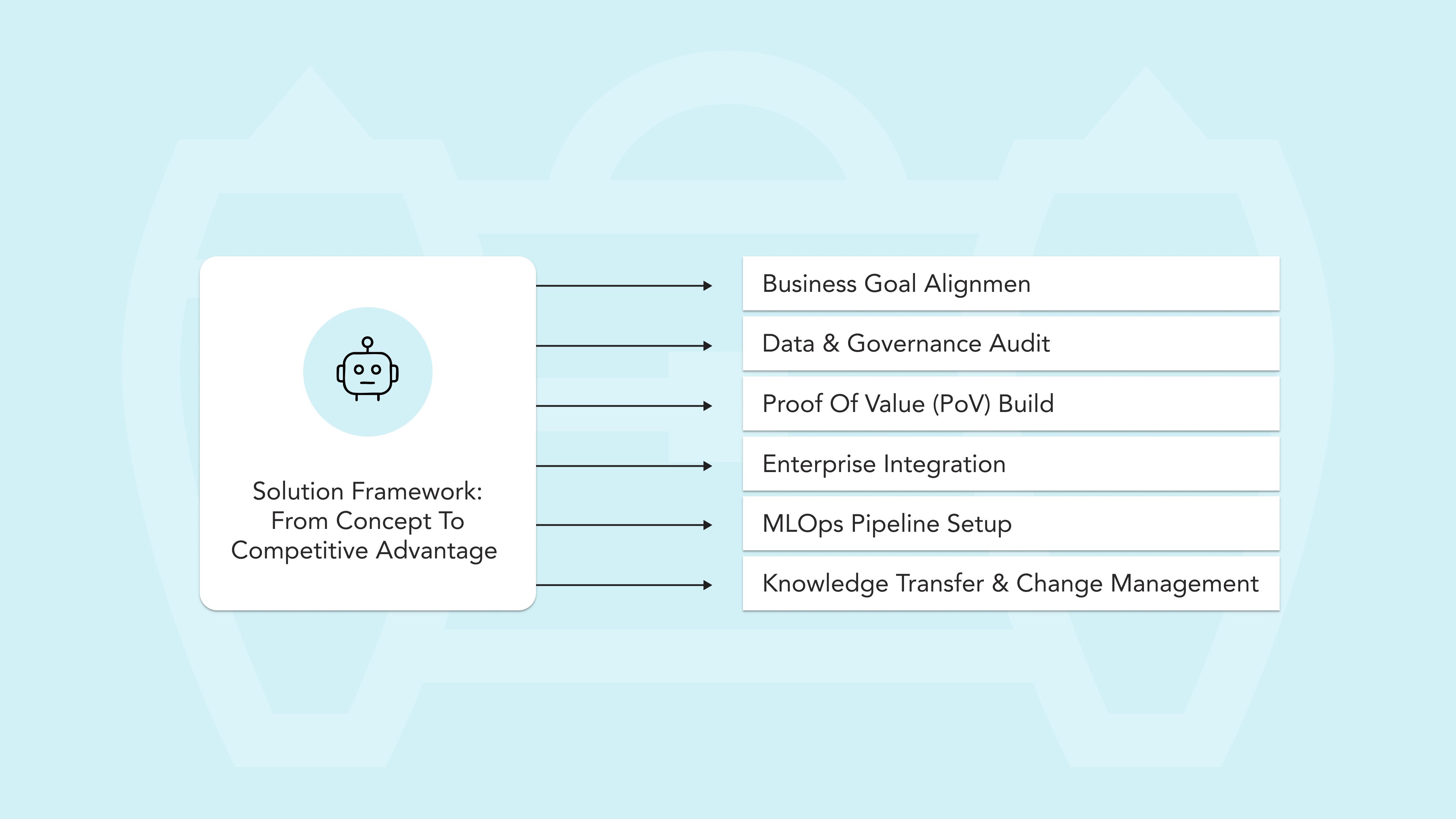
A lot of winning teams use a clear plan when deploying AI, focusing hard on covering integration and MLOps gaps. Smart businesses go with this setup so their tech isn’t just temporary, it grows over time.
Business Goal Alignment: Define the CRM implementation or API integration challenge that AI will solve.
Data & Governance Audit: Establish robust data synchronization strategies and ethical guardrails.
Proof of Value (PoV) Build: Rapidly create a limited scope model that proves the business case within 6 8 weeks.
Enterprise Integration: Implement the necessary API integration protocols and connect the model to legacy systems.
MLOps Pipeline Setup: Build automated CI/CD and monitoring for continuous improvement.
Knowledge Transfer & Change Management: Train internal teams and manage organizational change for successful AI adoption.
What This Means for Your Business: A scalable, secure AI software development company solution that integrates seamlessly into the enterprise architecture.
FAQs: Addressing Executive Concerns
Q1: Why do so many AI projects fail to reach production, and how can we avoid that outcome?
Many initiatives don’t work since suppliers fixate on the math part while overlooking how tough it is to plug that logic into current business systems or data setups, so insist your ML development company includes workflow automation, interface linking, and skill sharing right from the start.
Q2: What is the real difference between a traditional software vendor and a dedicated ai ml development company?
A typical seller might toss in AI like an extra feature, yet a specialist ai/ml development company puts the whole model journey front and center. Instead of just hiring regular coders, they bring in data experts plus machine learning pros who actually live this stuff. Rather than skip steps, they apply MLOps methods to keep things running smoothly. Their goal isn’t slapping up a model once but constantly tweaking it, so when your business data shifts, the system keeps pace without missing a beat.
Q3: How should we measure the ROI of a successful ML development company partnership?
Track returns by looking at numbers that actually matter to the company. Instead of generic stats, pay attention to things like lower running expenses, better sales predictions, fewer customers leaving, or faster workflows. Aim for real gains, solid progress counts more than perfect model scores.
Q4: We have legacy systems. Is seamless integration realistically possible with a modern AI & ML development services company?
Yeah, it can work, though you’ll need someone skilled at enterprise integration. Because they’ve got to know how to custom build APIs, upgrade legacy system protocols, and handle complex data flow setups. Otherwise, the whole thing just sits alone, useless.
Q5: What is the most important non technical factor in selecting an AI software development company?
The main point is making sure goals match while sharing know-how. Pick a AI ML development company that starts by asking about your business needs, gets how your field works, then shows exactly how they’ll teach your internal crew to handle and keep the system running far into the future.

The race in 2025 won’t wait for clunky, isolated AI software development company projects. Firms getting ready today for Agentic AI will dominate the pack tomorrow. Picking your ml development company ranks among this year’s biggest calls. Skip flashy tech talk look at real results, how it fits your operations, or whether it can grow when needed.
The real issue isn’t about picking an AI ML development company; it’s about when you’ll build a strong, connected, money-making system. Ready to push your team into the top 20% of companies that are actually pulling off AI.