





The CEO of a medium-sized insurance company recently sat in a boardroom and looked at a dashboard that was three days old. His team was frantically trying to put together claim data from PDFs, emails, and phone logs by hand. Meanwhile, his biggest rival had just processed a complicated claim in four minutes.
The other person wasn't using magic. They didn't hire a whole army of data scientists. They had just gotten past the "hype phase" of AI. The CEO was still thinking about whether or not to use a basic chatbot, but the competitor had already used Agentic AI, which are autonomous systems that do more than just chat.
The time of "AI experimentation" is over as we move into 2026. We are now in the age of AI Utility.
The question for business leaders is no longer whether or not they should invest in technology, but which technologies will give them a good return on investment. There is a lot of noise in the landscape. This guide cuts through the noise and lists the most important new technologies that AI software development companies are focusing on for 2026. It also shows how your business can use these technologies to build a competitive edge and be ahead.
The "Innovation Gap": Why 2026 is a Pivot Point
Generative AI (GenAI) was the most important thing in the last two years. People were amazed that an LLM could write a poem or summarize an email. But a poem doesn't help the bottom line for the C-suite.
Forbes says that soon GenAI will slow down because the costs will be higher than the value. This isn't AI's fault; it's the strategy's fault. Instead of building "capabilities," companies bought "tools."
The change for 2026 is toward independence and integration. It's about going from models that "think" to systems that "do." This is where a strategic AI development company like Chirpn comes in. They help businesses connect the dots between cool demos and important workflows.
5 Emerging AI Technologies to Watch (and Adopt) in 2026
If you are planning your technology roadmap, these are the five pillars that should define your strategy.
1. Agentic AI: From "Chatbots" to "Digital Employees"
The biggest change in 2026 is the switch from passive AI (like chatbots) to agentic AI.
A normal chatbot waits for a message. It gets information. It's a librarian.
Agentic AI has power. It sees a goal, breaks it down into steps, and then takes action across all of your software.
- The Use Case: An AI Agent watches the sales rep's email, finds a "Hot Lead," automatically updates the Salesforce record, checks the ERP for product availability, and writes a contract for the rep to sign. This is better than having the sales rep do it by hand.
- Why It's Important: This is what the "AI-Powered Force Multiplier" looks like. It makes it easier for your human teams to think, so they can focus on strategy while agents take care of the execution.
2. Small Language Models (SLMs): Efficiency at the Edge
The saying for the last two years has been "bigger is better." People talked a lot about big models like GPT-4. The trend is going back toward Small Language Models (SLMs) in 2026.
Not every issue in business needs a model with a trillion parameters. SLMs are small, very efficient models that can run on local devices (edge computing) or private servers without costing a lot of money for GPUs.
- The Use Case: A company that specializes in AI ML development can train a small SLM using only your own legal documents or technical manuals. It runs on your computer, so there is no data leakage and latency is lightning fast. It costs a lot less than a huge LLM.
- Why It Matters: Keeping costs down and protecting privacy. SLMs let businesses use more AI without their cloud bills getting out of hand.
3. Multimodal AI: Beyond Text
Most enterprise AI worked with text until recently. Multimodal AI changes the game by letting systems process and connect different types of data at the same time, like audio, video, images, and text.
- The Use Case: Visual inspection systems in manufacturing don't just "see" a problem. They also use the image, the maintenance manual (text), and the sound of the machine (audio) to figure out what went wrong in real time.
- Why It's Important: It works like how people see things. An expert in AI ML development services can make systems that know what's going on in your physical operations as well as your digital ones.
4. AI-Augmented Software Development (The "Rapid Launch" Standard)
Artificial intelligence is changing the way software is made at its core. We are getting away from manually coding boilerplate tasks.
We use this in our Rapid Launch method at Chirpn. AI tools can now make test cases, write documentation, and build infrastructure code (IaC).
- The Use Case: Speeding up the Software Development Life Cycle (SDLC). It used to take about six months to build an MVP, but now it can be done in about six to twelve weeks.
- Why It Matters: Getting to market quickly. Your AI software development company should use AI to build your AI. This will cut the time it takes to get value from it by 40–50%.
5. Automated MLOps and Self-Healing Models
When companies go from one model to one hundred models, maintenance becomes a nightmare. Automated MLOps will be widely used by 2026.
These are systems that keep an eye on your AI models while they are in use. If a model's accuracy goes down (data drift), the system automatically starts a retraining pipeline with the most recent data, checks the new model, and deploys it, usually without any help from a person.
Strategic Framework: How to Implement These Technologies
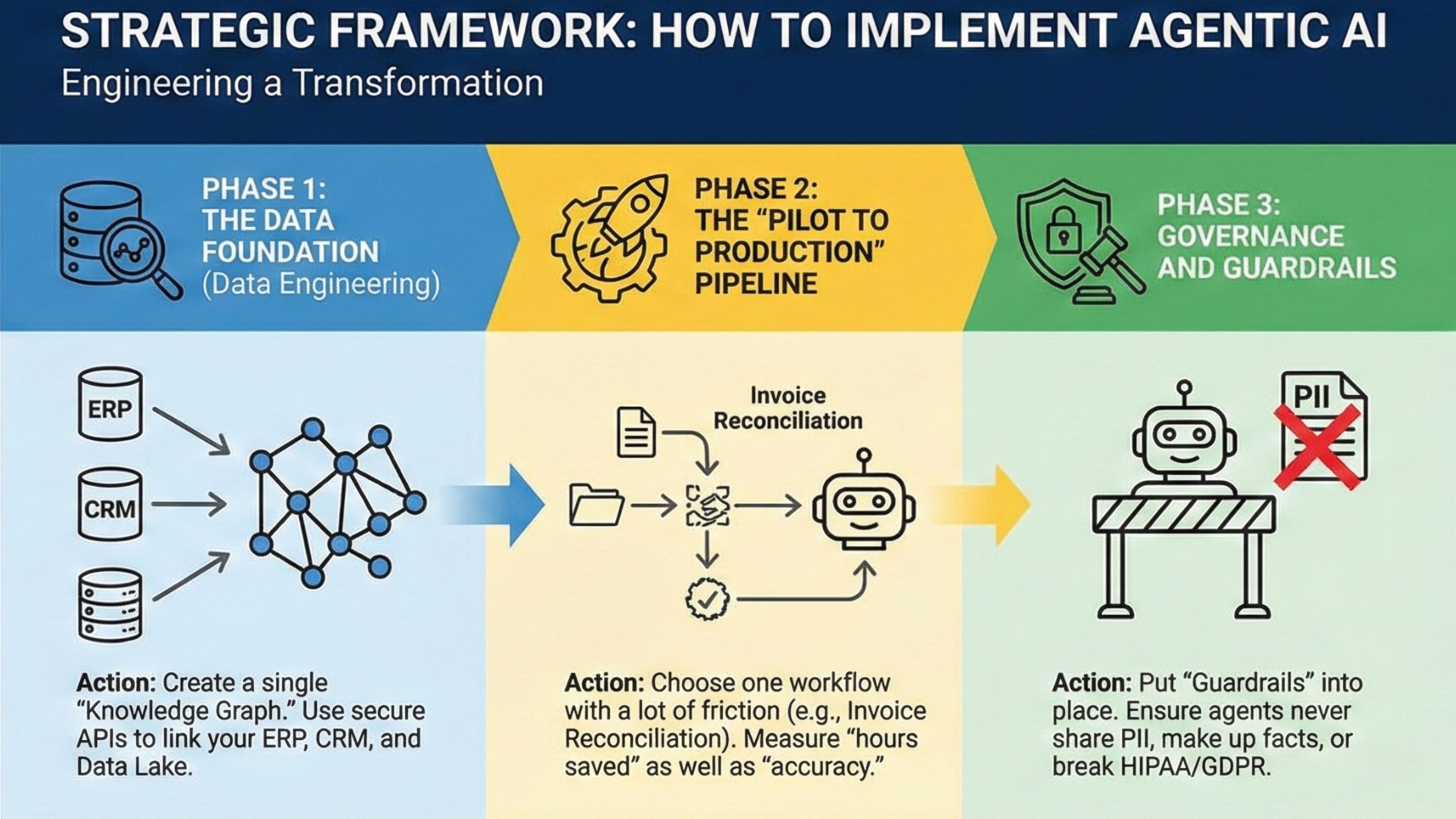
Adopting these technologies is not about buying a license; it's about engineering a transformation. Here is the framework we recommend to our enterprise clients.
Phase 1: The Data Foundation (Data Engineering)
You can't make Agentic AI with bad data. You need to check your data silos before you hire ai ml development services.
- Action: Create a single "Knowledge Graph." Use secure APIs to link your ERP, CRM, and Data Lake. To work, your AI agents need to be able to access these systems with permission.
Phase 2: The "Pilot to Production" Pipeline
Stay away from "Pilot Purgatory." Don't start with a huge change.
- What to do: Choose one workflow with a lot of friction, like "Invoice Reconciliation" or "Level 1 Customer Support." Work with an AI development company to make a custom Agentic solution for that loop. Don't just look at "accuracy" as a measure of success; look at "hours saved" as well.
Phase 3: Governance and Guardrails
As models become better, the risks go up.
- Action: Put "Guardrails" into place. This makes sure that your SLMs or Agents never share PII (Personally Identifiable Information), make up facts, or break compliance rules like HIPAA and GDPR.
ROI Analysis: The Cost of Inaction
Why should a CFO approve the hiring of AI software development companies in 2026? Because the operational leverage is undeniable.
Metric | Traditional Enterprise Process | AI-Augmented Enterprise (2026) |
Workflow Speed | Human speed (Days) | Machine speed (Minutes/Seconds) |
Error Rates | 3-5% (Human fatigue) | < 0.5% (Consistent execution) |
Development Time | 9-12 Months for MVP | 6-12 Weeks (Rapid Launch) |
Customer Service | 9-5 Availability | 24/7 Agentic Resolution |
OpEx Trend | Linear growth with scale | Non-linear (Scale without adding headcount) |
Chirpn Insight: We have seen that clients who add Agentic AI to their old systems usually see a 30–40% drop in operational processing costs within the first year.
Conclusion: Adapt or Obsolesce
Agentic AI, SLMs, and multimodal systems are not science fiction; they are real technologies that will be available in 2026. They are the new standard for how well things work.
The gap between the best and worst in the market is getting bigger. The best companies are the ones that see AI as an investment in infrastructure and work with a specialized AI development company to make it a part of their business.
You have the information. You have the idea. Now you have to do it.
Do not let the future wait.
Chirpn is your partner if you want to go from "AI experimentation" to "AI utility." We have the knowledge, "Rapid Launch" speed, and experience to make these new technologies work for you and give you an edge.
Ready to modernize your enterprise? Explore our Artificial Intelligence & Machine Learning Explore our services or learn more about our Platform and Product Development capabilities today.