





For most growing businesses, CRM implementation isn’t the problem; making it deliver measurable business outcomes is.
Many companies invest in CRM platforms with high hopes of better forecasting, streamlined sales, and deeper customer insights. Yet, six months later, adoption rates fall flat, reports are inconsistent, and leadership struggles to extract meaningful insights from piles of data.
This arises due to a data intelligence gap. And that’s exactly where AI-driven CRM Implementation Services close the loop.
AI doesn’t make your CRM “smarter” in the marketing sense. It makes it more operationally accurate, contextually aware, and decision-ready, so every interaction in your pipeline, marketing, and support ecosystem contributes to revenue.
1. CRM Implementation Services Are Changing — AI Is the Reason
The role of a CRM has evolved from tracking contacts to orchestrating entire customer journeys. But that complexity demands precision.
AI transforms CRM implementation from configuration to calibration.
Instead of customizing modules based on assumptions, AI analyzes your existing workflows, customer data, and historical performance to design configurations that actually map to how your teams operate.
Let’s take an example:
- In a traditional CRM rollout, you define lead scoring rules based on intuition — say, form fills or email opens.
- In an AI-led implementation, algorithms study your past closed deals and engagement touchpoints to define data-driven lead scoring models that evolve as your sales cycle does.
The outcome? A CRM that doesn’t just track activity but learns what success looks like for your specific business.
2. Strategic Data Foundations: Where AI Adds Immediate Value
Most CRM implementation projects fail quietly in the data phase. Bad data leads to bad automation, bad insights, and eventually, bad decisions.
AI fixes this upfront.
During the CRM implementation process, AI models clean, match, and normalize legacy data before migration. Instead of relying on human-led data cleansing (which typically addresses 60–70% accuracy), AI tools can identify anomalies, detect duplicates across systems, and enrich customer profiles with publicly available business information.
This step alone can increase CRM usability and reporting reliability by 30–40%, according to McKinsey research.
From a business lens:
- Your sales pipeline reflects reality, not inflated lead counts.
- Your reports reflect true conversion patterns, not flawed attribution.
- Your forecasting model has credible data inputs from day one
3. Using AI to Shorten the CRM Adoption Curve
Every executive knows that the success of CRM implementation hinges on user adoption. AI can accelerate this by turning complexity into simplicity.
Instead of static dashboards, AI-powered CRMs offer adaptive interfaces, surfacing what each role needs to see, when they need it.
- For sales reps: AI suggests next-best actions based on deal stage and historical outcomes.
- For marketing teams: It auto-syncs campaign responses and updates lead scores in real time.
- For leadership: It generates performance summaries and anomalies, without manual report building.
When teams see immediate value, they engage.
When engagement grows, CRM data quality improves.
4. From Automation to Intelligence: CRM and Marketing Alignment
One of the most underused opportunities in CRM implementation services is connecting it tightly with marketing automation.
AI acts as the strategic link between the two.
- It identifies which campaigns generate the highest deal velocity, not just lead volume.
- It refines targeting by analyzing behavioral data across channels.
- It recommends when to re-engage leads that dropped off the funnel.
This integration helps executives answer questions that standard CRM dashboards can’t:
“Which marketing activities actually influence closed deals?”
“Where do leads stagnate in our cycle, and why?”
By integrating AI across CRM and marketing, businesses move from a linear funnel to a continuous revenue loop, one that learns and improves with every cycle.
5. Real-Time Customer Intelligence for Proactive Engagement
A traditional CRM tells you what happened. An AI-enhanced CRM tells you what’s about to happen.
Post-implementation, AI-driven systems constantly monitor engagement signals across email, chat, social, and purchase data to anticipate customer behavior.
- Churn prediction: Identifies accounts showing early disengagement patterns.
- Upsell forecasting: Spots customers entering expansion-ready phases based on usage metrics.
- Sentiment intelligence: Detects tone and context from customer communication.
The insight here isn’t about automation, it’s timing.
When teams act at the right moment with the right message, conversion probability rises sharply.
Forrester’s 2024 CRM Impact Report found that businesses using AI-based engagement triggers saw a 32% increase in customer retention within the first year.
6. The AI Layer in the CRM Implementation Process
Stage | Traditional Implementation | AI-Enhanced Implementation |
| Discovery | Business requirements gathered manually | AI analyzes workflows, sales data, and team usage patterns to identify bottlenecks |
| Data Migration | Manual cleansing and import | AI performs data deduplication, normalization, and enrichment |
| Customization | Fixed workflows designed by developers | Adaptive automations based on predictive models |
| Adoption & Training | One-time sessions | Continuous learning dashboards tracking adoption rates |
| Post-Go-Live Optimization | Reactive troubleshooting | Predictive analytics monitoring usage and forecasting ROI impact |
AI shifts CRM implementation from a setup exercise to an iterative intelligence system.
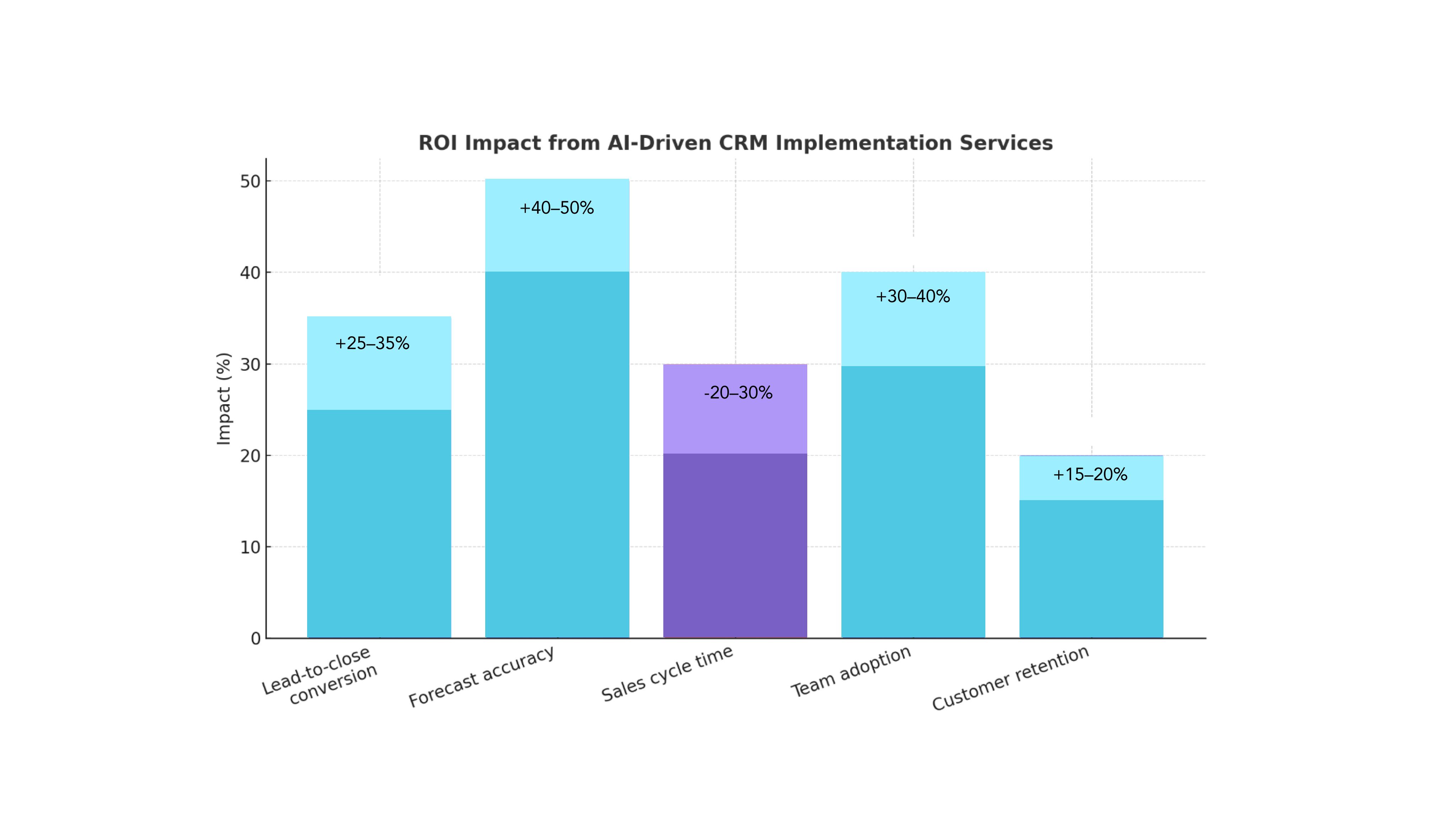
7. Measuring ROI from AI-Driven CRM Implementation Services
Decision-makers rarely care about “AI features.”
They care about what they can measure.
Here are metrics that improve when AI is embedded in CRM implementation services:
Metric | AI Impact |
| Lead-to-close conversion | +25–35% via predictive lead scoring |
| Forecast accuracy | +40–50% through data modeling and anomaly detection |
| Sales cycle time | -20–30% due to automated workflows |
| Team adoption | +30–40% with adaptive UX and contextual prompts |
| Customer retention | +15–20% through proactive engagement alerts |
The point is about decision precision.
AI makes your CRM less about managing data and more about managing outcomes.
8. CRM as an Evolving Intelligence Layer
A CRM implementation project shouldn’t end with deployment. When AI is part of the architecture, it becomes a continuously learning system.
Over time, the CRM adapts to:
- Market shifts (e.g., new pricing dynamics or buying cycles)
- Internal behavior changes (e.g., sales strategies, product launches)
- Data complexity (as more tools and platforms are integrated)
The longer your CRM runs with AI feedback loops, the sharper its predictive accuracy becomes, meaning your investment value compounds.
Businesses that treat CRM as a living intelligence asset rather than a one-time setup consistently outperform those that don’t.
9. Choosing the Right Partner for AI-Powered CRM Implementation
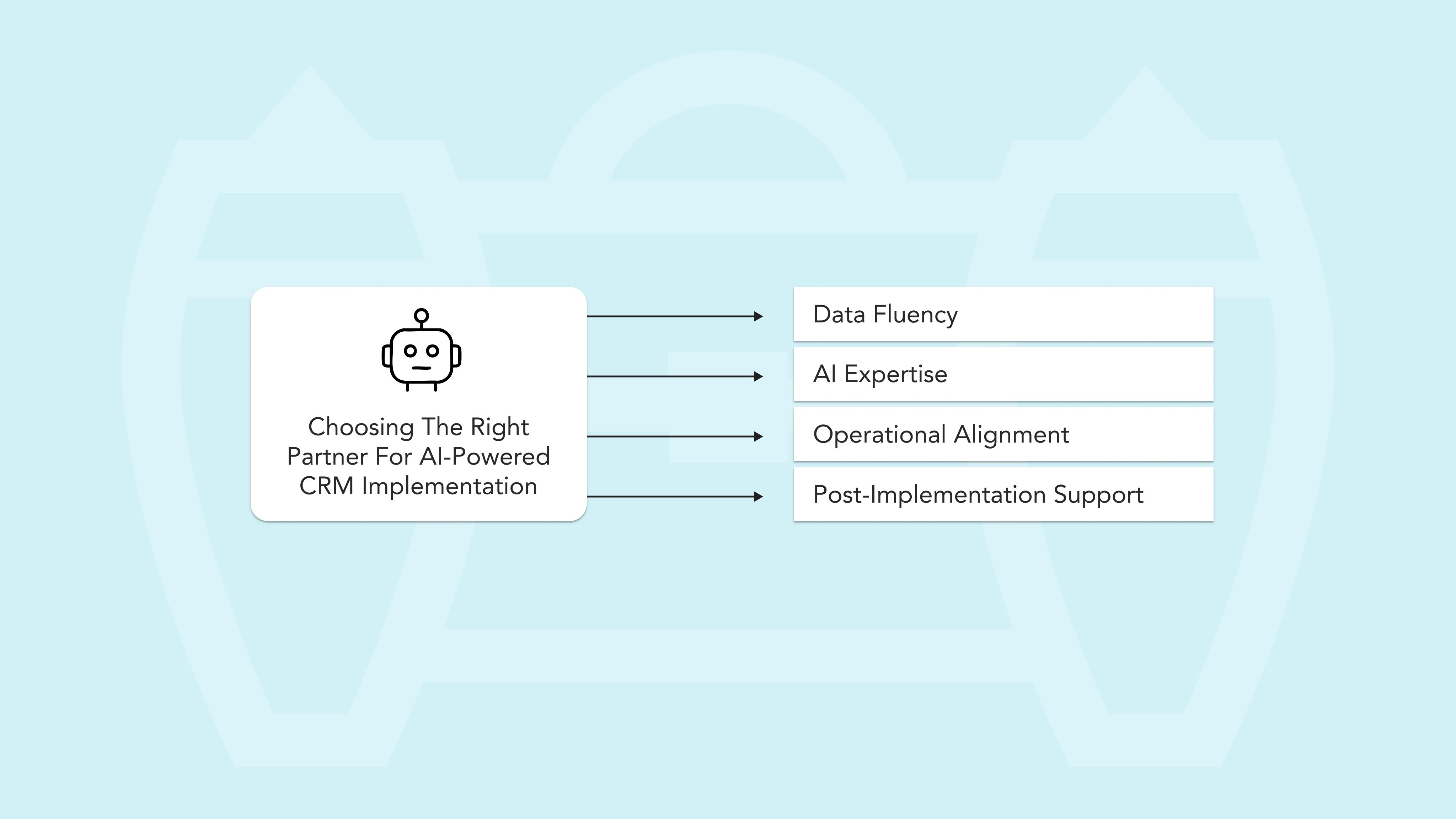
When evaluating CRM implementation partners, prioritize those who approach AI not as a feature, but as a strategic architecture layer.
Look for:
- Data fluency: Teams who can audit, clean, and model data before configuring CRM modules.
- AI expertise: Proven track record in applying predictive analytics and machine learning within CRM ecosystems like Salesforce or HubSpot.
- Operational alignment: Consultants who tie CRM outcomes to sales KPIs, not just system uptime.
- Post-implementation support: Ongoing AI model tuning, adoption analysis, and process optimization.
The best vendors don’t sell software setup, they co-design a decision-enabling system around your business model.
FAQs
1. How does AI change the CRM implementation process?
It replaces static workflows with adaptive intelligence, helping teams automate data tasks, improve forecasting, and personalize interactions at scale.
2. Can AI work with my existing CRM platform?
Yes. AI modules can be integrated into most leading CRMs (Salesforce, HubSpot, Microsoft Dynamics, Zoho) without a complete system overhaul.
3. What ROI can I expect from AI-enhanced CRM implementation?
Businesses typically see a 25–35% increase in lead conversions and up to 50% more accurate forecasts within the first 6–12 months.
4. Is AI integration expensive?
For most mid-sized businesses, AI features are now built into modern CRMs or available through scalable add-ons, making them more cost-effective than full custom development.
5. How do I ensure my teams adopt the new system?
Focus on role-specific automation and visible time savings. When users see real productivity gains, adoption naturally follows.
For decision-makers evaluating CRM Implementation Services, the question isn’t “should we use AI?” It’s how intelligently we’ll use it to make every customer interaction count, every forecast credible, and every sales motion data-driven.