





Companies compete less on product features and more on customer experience. For any enterprise aiming for sustainable, profitable growth, a reactive approach to customer needs is a formula for decline. This is why investing in a robust CRM implementation is a core customer-centric growth strategy. CRM, or Customer Relationship Management, is more than software; it is a system to increase the ROI manifold.
How the Right CRM Partner Turns Risk into Revenue Growth?
Research reveals that an adequate CRM system implementation will see an average ROI of more than $8.71 for each $1 invested as well as increase sales revenue growth by 29%. However, even though there are these obvious payoffs, more than 70% of the CRM projects are broadly defined as falling short or failing altogether. This contradiction of high reward and high-risk hints at a very important truth: the payback is wholly defined as the quality of the CRM implementation services that you pick. The correct partner takes a purchase of a piece of technology and turns it into a business transformation.
The Cost of Ineffective Customer Management
Before we define success, we must address the common pitfalls that lead to the high CRM failure rate. These obstacles are rarely technical; they are strategic, human, and organizational.
The Strategy Gap: Defining Success Before Software
One of the biggest mistakes in CRM for business is opting to buy a platform before defining the ultimate business objectives. Few businesses treat CRM as a strategic change agent rather than an IT implementation. They inevitably do so because they cannot pinpoint a clear vision on the specific ways the tool will directly improve sales cycles, accelerate services delivery, or improve personalization within marketing. When the objectives are vague, the system becomes a hodgepodge storehouse of data that doesn't produce any concrete outcomes.
A good CRM implementation methodology doesn't kick off with vendor short-listing. It starts with an inclusive, multi-departmental discovery phase to determine the current customer experience, including identification of process bottlenecks, as well as gathering CRM ROI metrics that matter such as improved customer churn or sales forecast accuracy.
The Data Mess: Migration and Quality Control
A CRM is no better than the data that is stored on it. Uploading existing customer records is a titanic task, and if there is no proper preparation, the risk is "garbage in, garbage out." Inferior quality data due to duplication, incompleteness, and inconsistency erodes team trust in the system, resulting in low uptake among users as well as inaccurate decision-making.
Data governance for CRM is a challenge that is often underestimated. It involves more than mere technical cleansing, including the definition of organizational entry and maintenance rules. Successful CRM implementation services involve a careful data audit, cleansing, as well as a data governance structure that maintains high data accuracy long after the flip of the switch. This careful procedure ensures that the new system becomes a source of truth, rather than confusion.
The People Problem: Driving Successful CRM Adoption
Technology is inert without engaged users. Low user adoption is the single biggest cause of CRM failure. Employees resist the change for practical reasons: the new system feels overly complex, requires too much manual data entry, or lacks integration with their existing tools. When the sales team finds the system cumbersome, they revert to spreadsheets, immediately undercutting the system’s value.
To gain successful CRM adoption at the enterprise, the system should make the user's job easier, not harder. This necessitates customized training as well as a change management program led by a champion that relays the why behind the system to each user role. Successful CRM implementation process is about workflows on the part of the user, keeping the customization minimized but accurate so that the system augments established, validated business processes.
A Proven CRM Implementation Methodology: Chirpn's Approach
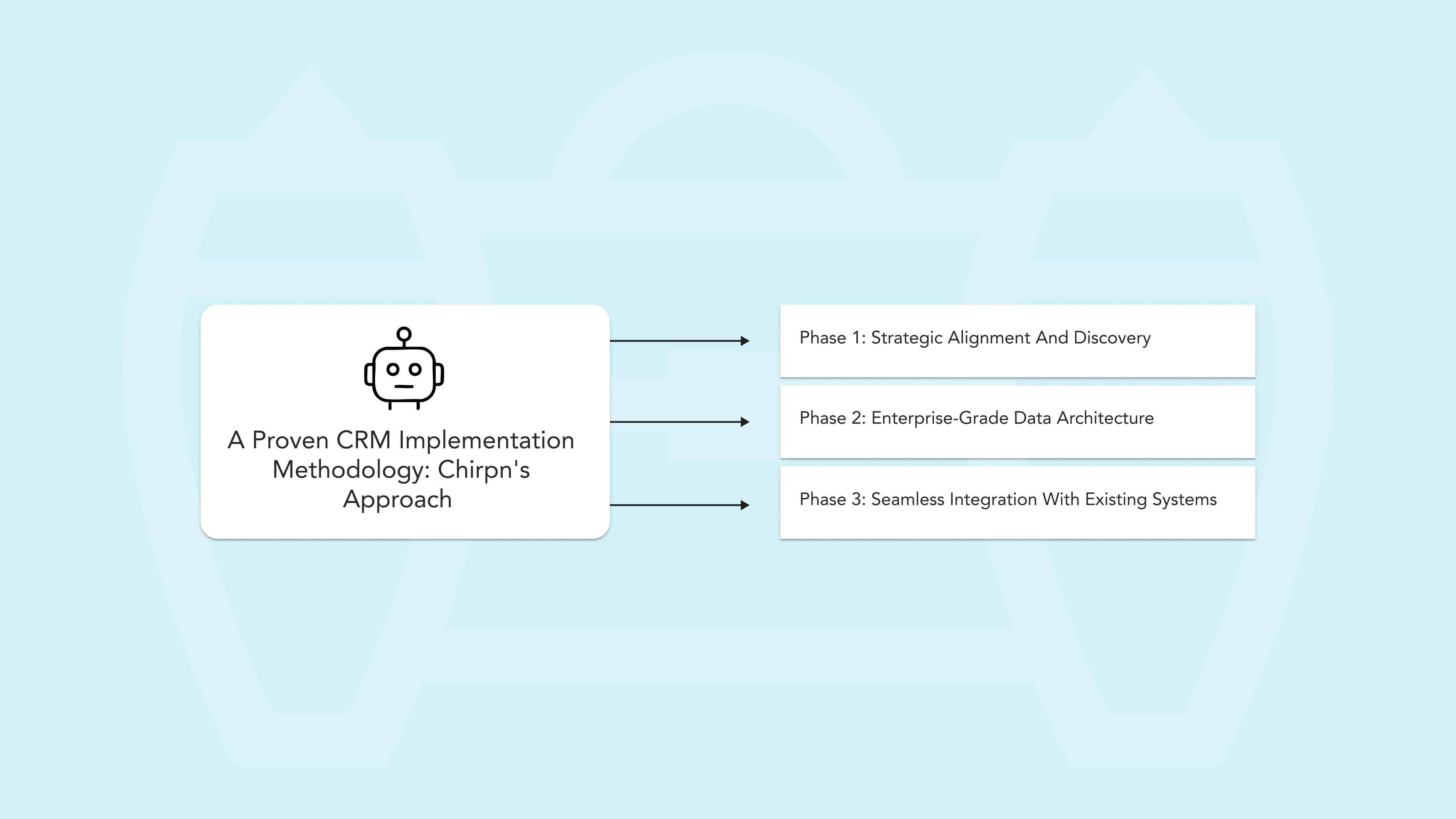
Chirpn engages with CRM as an engineering- and process-based business transformation, rather than as a software upgrade. Our CRM implementation services make the technology align best with your customer-centric growth strategy goals.
Phase 1: Strategic Alignment and Discovery
We begin by posing the correct questions to lay the foundation for CRM as the foundation of business profitability. Our specialists hold extensive workshops among sales, marketing, as well as the service departments to:
Define Success Metrics: Go beyond qualitative objectives such as "improved customer service" to concrete KPIs, e.g., "improve the average time taken to close cases by 15%."
Process Mapping: Plot existing workflows to identify where frictions occur, where opportunities to automate exist. Configurations on the CRM then proceed based on optimized workflows, so that the system facilitates, rather than dictates, the manner your team conducts business.
Read our CRM Case Study to learn more about its benefits.
Phase 2: Enterprise-Grade Data Architecture
Any large-scale CRM implementation has the data infrastructure as the foundation. Our CRM software services team establishes a strong data governance for CRM framework that:
Cleaning and Migrating: We use sophisticated utilities to review, clean, and remove duplicates from your data before migrating, so your new system is fully functional.
Sets Rules in Place: We set explicit, automated data validation rules within the CRM to regulate data governance as the standard henceforth, eliminating the manual error component and generating trust in the data.
This intense attention to data architecture is the factor that distinguishes a long-term enterprise CRM solution from a quick fix.
Phase 3: Seamless Integration with Existing Systems
Next-generation enterprise CRM solutions need to seamlessly consolidate the current-stack technologies ERP, marketing automation suites, as well as service desks. Non-integration gives rise to data silos, resulting in time wastage as well as isolated customer experiences. Our extensive engineering proficiency guarantees that:
No Silos Left Behind: We create custom connectors and APIs where native integrations are insufficient, so there is two-directional data flow between significant systems.
Workflow Automation: Automation is introduced throughout integrated systems, including automatically generating a support ticket within a service desk once a lead enters a defined stage within the CRM sales pipeline.
CRM Implementation Services Drive Tangible Growth

Done properly, CRM implementation has a direct impact on tangible business growth, driving the needle on revenue as well as retention.
Increasing Sales and Conversion Rate: Measurable Result
A centralized, organized CRM provides salesforces with superpowers. They shift back from having to spend time on paperwork tasks to selling. Organizations that use a properly implemented CRM experience a sales productivity gain of up to 34% and are capable of improving the accuracy of their sales forecast beyond 42%.
By executing the system to automate lead scoring, personalizing communiqués, and closing sales cycles, properly implemented CRM becomes most valuable among Best CRM implementation tools. It is this contribution to generating direct revenue that gives strong ROI metrics to CRM.
Elevating Service Quality and Retention
Customer retention is the very basis behind customer-centric growth strategy. Customers are as likely as 68% to leave a company due to the perception that they don't care instead of a product. This is addressed by the CRM software services, which provide an integrated, 360-degree view of all customer interactions.
This point of truth equips the service agents to rapidly resolve issues as well as deliver personalized interactions, boosting customer retention up to 27%. Long-term relationship management is the signature of an effective CRM for business.
Explore how our core engineering capability supports long-term growth via Enterprise Platform Implementation.
Selecting the Right Technology
Selecting the appropriate CRM platform is paramount, yet it must be a decision that comes after strategy, rather than dictates strategy. No single system is best; there is only best CRM implementation methodology. Our task is to offer an impartial, expert evaluation of platforms (i.e., Salesforce, Microsoft Dynamics, HubSpot) to your defined operational and strategic needs. We help you pick a scalable, future-proofed solution that aligns with your long-term enterprise CRM solutions strategy.
Securing Your Future with Expert CRM for Business
A successful CRM implementation is a continuous transformation. As the international CRM market will continue to expand past $129 billion come the year 2028, AI and generative AI play an even bigger part. Staying ahead requires a partner that understands the art of constant optimization.
Post-Launch Optimization
Effective CRM implementation services provide future-proof post-deployment support and optimization. We set up processes to regularly solicit user feedback, determine where there is the potential to automate more, and incorporate newer technologies such as predictive AI so your company takes the past data and makes it a future opportunity. This ongoing refinement of CRM for business gives your business a competitive advantage.
Why some CRM initiatives become investments that pay off, rather than expensive disappointments, is the CRM implementation services that pave the way. A seasoned partner, emphatically qualified technically, that employs strategy-driven methodologies, gets the technology working on behalf of your business, rather than the other way around.
Keen to begin your successful CRM implementation phase and chart a customer-focused growth strategy? Avail a strategic session today with Chirpn.
Frequently Asked Questions
Q1: What are the main risks associated with CRM implementation and how can we mitigate them?
Primary threats include low adoption among users, inadequate data quality, and no apparent strategic objectives. We address this through successful CRM adoption as a high priority through customized training and keeping the interface easy to use, and through imposing rigorous data governance for CRM policies during the initial data audit period.
Q2: How can we measure the CRM ROI metrics to justify the CRM implementation services investment?
Your ROI is measured by the following numeric metrics that are related to your company objectives. Primary metrics are the decrease in the length of the sales cycle, the lead conversion rate increase, the sales forecasting accuracy improvement, and the percent increase in the customer post-implementation retention.
Q3: What is the first step a business should take before choosing the right CRM platform?
It doesn't come first, the choosing of the software, but rather, the extensive discovery phase. You need to outline your precise, measurable business objectives, your current customer experience, as well as the functional needs the new system must fulfill, so there is a good CRM for business fit.
Q4: Our existing data is messy. Can a provider of CRM software services help with data migration and cleanup?
Yes. Effective CRM software services include a meticulous data migration process that covers pre-migration data purifying and deduplication, as well as configuring auto-data validation rules. It is necessary to avoid data integrity issues that often plague new enterprise CRM solutions.
Q5: How do we ensure long-term successful CRM adoption after the initial CRM implementation is complete?
Ensure long-term effective CRM adoption through the provision of routine, job-centered training, the identification of internal CRM champions; and ensuring there is a strong defined loop back to users. Regularly review, improve, and tune the system to keep it current with evolving user workflows as well as current business goals.