




Have you ever wondered these days why startups prefer AI-Driven product development companies. A decade ago, when we first started engineering digital solutions for the global market, the ask from a founder of a startup was simple: "Build me a web app." The preoccupation was clean code, responsive design, and, where relevant, a migration to the cloud. Speed was measured in quarters. Success was measured in uptime.
Fast forward to 2025: the ask is fundamentally different. Founders and Enterprise CTOs aren't asking for "apps." They are asking for intelligence: platforms that predict user behaviors, create content, and manage complex workflows autonomously.
It forms the most significant architectural shift the industry has ever seen since the move from on-premise servers to the cloud. And in that new era, traditional "Software Dev Shop" vendors that just trade hours for code are becoming obsolete.
More and more, startups and mid-size SaaS leaders are bypassing generalist vendors in favor of a specialized AI product development company. They are searching for partners who understand that building software today isn't just about writing logic; it's about orchestrating data, managing MLOps, and integrating AI-powered applications into the core of the business.
As a veteran technology partner that has navigated a decade of tech cycles from the mobile boom to the cloud revolution and now the AI age we have analyzed why this shift is happening. Here is the strategic case for the AI-driven partner.
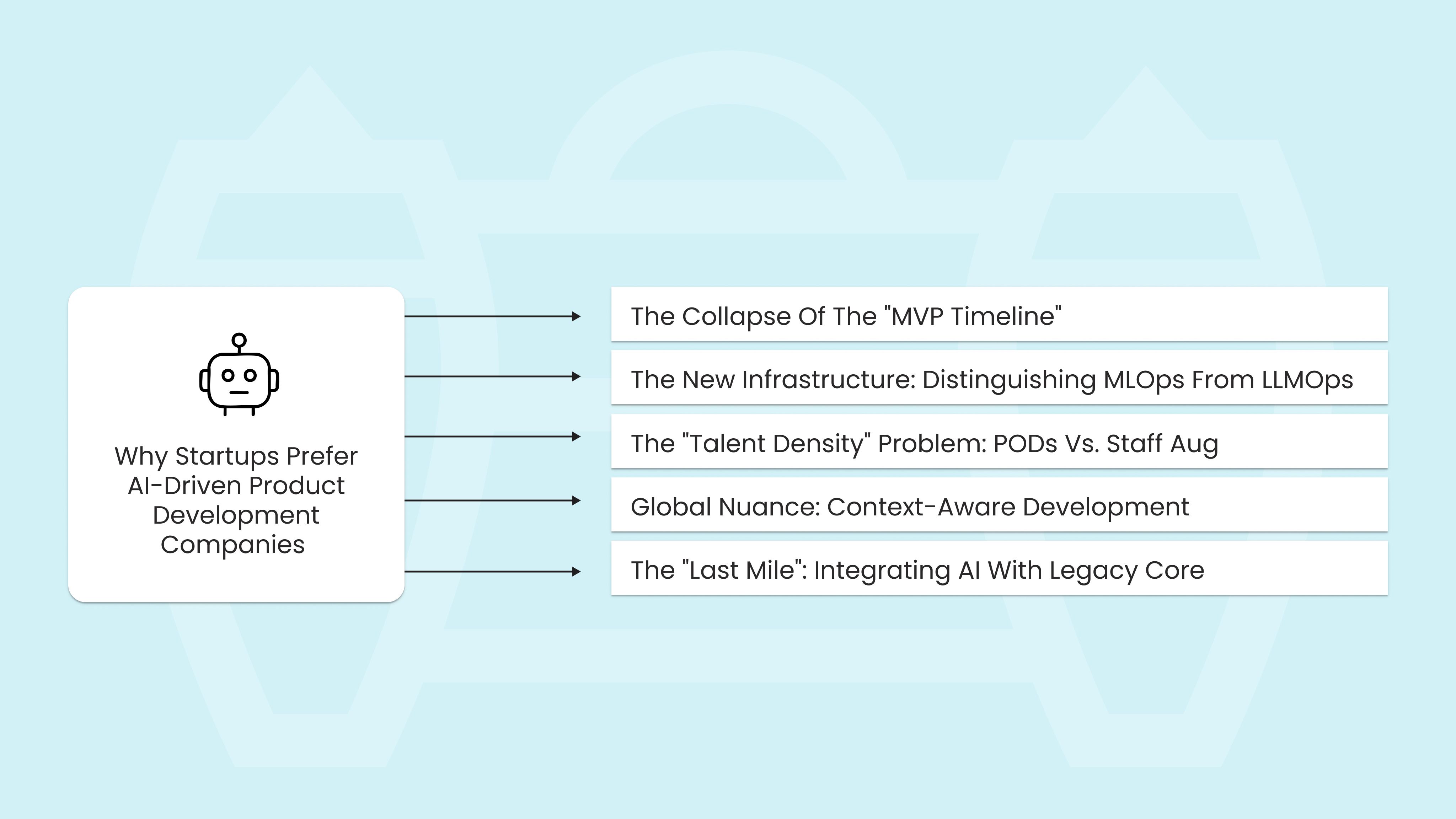
The Collapse of the "MVP Timeline"
In 2015, it was standard operating procedure to spend six to nine months building an MVP. In the modern venture capital climate, a nine-month build is a liability.
The main driver in choosing an AI development company is compression of time. However, this isn't about developers typing faster. It's about a fundamental change in the SDLC, or Software Development Life Cycle.
From Manual Coding to AI Orchestration
Traditional product development services rely on linear, manual processes. You write the boilerplate, you set up the database, you write the tests. It's a "waterfall" of human effort.
An AI-first development partner is different. We look at the SDLC from the perspective of automation.
Automated Infrastructure: Using AI to generate IaC scripts that set up cloud environments in minutes, rather than days.
The "Rapid Launch" Methodology: Over the last years, top companies have been perfecting a process whereby AI tools take care of the repetitive 40% of coding; that is, authentication, standard APIs, CRUD operations.
This allows senior engineers to focus entirely on the unique business logic. The result? We are seeing complex product prototypes delivered in ~6 weeks and market-ready MVPs in ~90 days. For a startup burning cash, this acceleration is not a luxury; it's survival.
The New Infrastructure: Distinguishing MLOps from LLMOps
Ten years ago, "infrastructure" meant servers and databases. Today, it means AI Infrastructure.
A common pitfall we see with modern startups is the assumption that "AI" is a single feature you plug in via an API. It isn't. It's an architectural layer. A true software product development services partner distinguishes between the two critical types of AI operations: MLOps and LLMOps.
MLOps: The Predictive Backbone
This is the mature side of AI. If you are a fintech startup in New York building a credit scoring model, or a logistics firm in Pune optimizing delivery routes, you are dealing with structured data (numbers, categories, SQL).
- The Requirement: You need MLOps (Machine Learning Operations). This involves building repeatable pipelines that retrain your models as new data comes in, ensuring they don't "drift" or lose accuracy over time.
- The Partner Role: We build the factory that keeps the model fresh, automated, and reliable.
LLMOps: The Generative Frontier
This is the new wave. Whether you're building a customer service bot or a legal tech summarizer, you will be dealing in unstructured data: text, PDFs, images.
- The Requirement: You need LLMOps. For this, you need a different stack completely: Vector Databases, Prompt Engineering, and RAG (Retrieval-Augmented Generation) architectures.
- Partner Role: We architect the system to "ground" the AI in your particular data, avoiding hallucinations and making the AI speak the voice of your brand.
Generalist dev shops often lack this distinction. Comprehensive ai software development services must encompass both predictive and generative stacks to build a foundation that lasts.
The "Talent Density" Problem: PODs vs. Staff Augmentation
In an AI world, you can't just build a coherent product by hiring three random freelancers or staff augmentation. You need a unit.
The scarcity of AI talents, which includes engineers who understand both platform development and LLM integration, has driven the market toward the Capacity POD model.
The Shift to Cohesive Units
Startups prefer specialized partners because we offer more than just "bodies"; we provide "capabilities."
- Capacity PODs: We deploy pre-vetted, self-managed teams comprised of, say, a Data Scientist, a Backend Architect, and a DevOps lead that have worked together in the past. That comes complete with best practices and communication shorthand.
- Build-Operate-Transfer (BOT): This technique is the gold standard for scale-ups and enterprises, especially for those looking to leverage AI outsourcing for cost efficiency. We build the center, we operationalize the AI culture, and then we transfer the asset to you.
This instantly provides a US healthcare firm or a government entity access to a mature. We foster an software development culture that eliminates the need for a multi-year ramp-up time.
Global Nuance: Context-Aware Development
Having operated across the USA, India, and the Middle East for a decade, we know that code might be universal, but context is local. A product development company that ignores regional drivers is likely to fail.
USA: The Compliance Moat
Innovation is high in Silicon Valley and the wider US market, as is regulatory scrutiny.
- The Challenge: Integration of GenAI in healthcare or finance has to be strictly HIPAA and SOC2 compliant.
- Our Approach: We implement "Guardrails" in our enterprise AI solutions. This ensures that, while the AI is creative, it never crosses privacy lines or exposes PII personally identifiable information.
India: The Scale Challenge
India is a mobile-first, high-volume market. A successful app here hits millions of users faster than in almost any other place.
- The Challenge: Cloud costs at scale can spiral out of control.
- Strategy: We specialize in "FinOps" and serverless architecture. We help our customers architect systems that scale down to zero when not in use and scale instantly when the load spikes, thus optimizing the unit economics for the Indian startup ecosystem.
GCC: The Transformation Mandate
In Dubai and Riyadh, discussions often center around macro-level Digital Transformation: Vision 2030.
- The Challenge: Moving large, paper-based government or enterprise workflows onto the cloud.
- Approach: Our approach focuses on legacy modernization by digitizing and classifying historical records using AI. This process will turn decades of physical archives into searchable and actionable digital knowledge bases.
The "Last Mile": Integrating AI with Legacy Core
Perhaps the most valuable lesson from our 10-year journey is this: New tech must play harmoniously with old tech.
Most startups and agencies are 100% focused on the shiny new AI interface. But if that AI can't read data from a 15-year-old ERP system or write orders into a legacy CRM, then it is no more than a toy.
Real value lies in APIs & Integrations.
- The Reality: Most enterprises run on platforms like SAP, Oracle, or customized on-premise SQL servers.
- Solution: We specialize in the "Last Mile" of integration: building secure API layers to permit modern, cloud-native AI agents to safely interact with legacy cores.
This is the reason why mid-size SaaS leaders choose us: they do not want to rip and replace their whole backend but rather an AI-powered force multiplier atop it to unlock new value from existing data.
Conclusion
The shift from traditional software development to AI product development is not a trend; it's the new baseline.
It's no longer just about who can write code the cheapest for founders and CTOs; it is about who understands the architecture of intelligence. It has to do with finding that partner with the ability to navigate the complexities of LLMOps, deploying distinct Capacity PODs to fill talent gaps, and grasping global market nuances.
We've spent the last decade building muscle memory for high-stakes software engineering. Today, we're applying that discipline to the AI revolution. We don't just build products; we build intelligent ecosystems that scale.
The technology is different, but the mission remains unchanged: to be that AI-powered force multiplier to make your vision a scalable reality.
Ready to future-proof your platform? Contact our AI experts for a consultation on how we can accelerate your roadmap.