



Most people hear "Model Context Protocol" and assume it’s about memory, specifically how much an AI model can process at once. That’s the wrong idea.
MCP isn’t about memory at all. It’s about how AI agents connect to your business applications. Think of it as APIs built for the agent era, a new way for intelligent systems to work with your CRM, analytics tools, financial software, and more.
Why Traditional APIs Aren’t Enough for AI Agents
Traditional REST APIs were designed for applications to talk to other applications. They’re predictable, structured, and static—like two databases exchanging rows of data.
But AI agents don’t work that way. They operate more like a smart assistant who asks questions, follows up, and takes action based on what they learn. That requires flexibility, adaptability, and context awareness—things static APIs can’t provide.
With traditional API integration, workflows have to be hard-coded. If the business needs a shift, the integration breaks. AI agents, on the other hand, need to:
- Explore data dynamically, based on real-time context
- Chain multiple operations together intelligently
- Preserve context across multi-step workflows
- Adapt based on feedback and ambiguity
That’s exactly where the MCP protocol comes in.
Breaking Down MCP Architecture
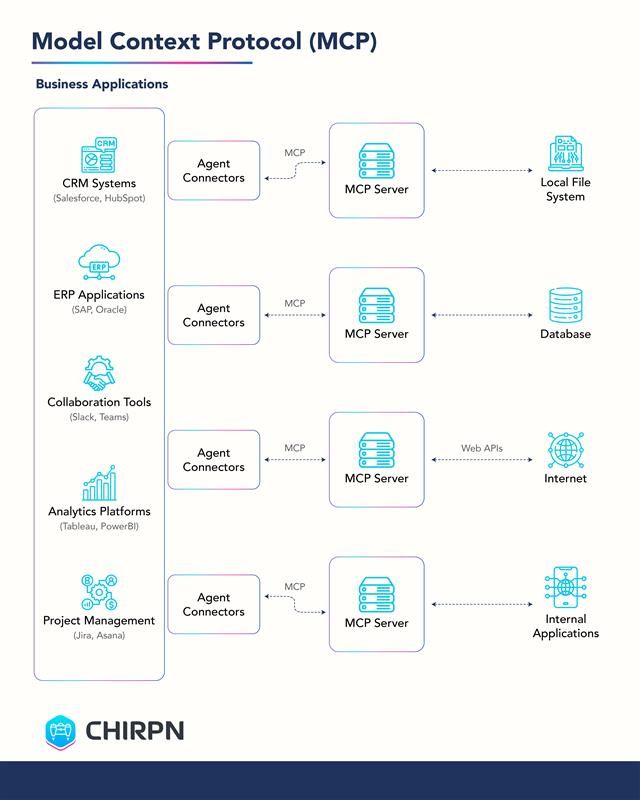
To understand how MCP works, let’s look at its core architecture. MCP Architecture is built around three main components:
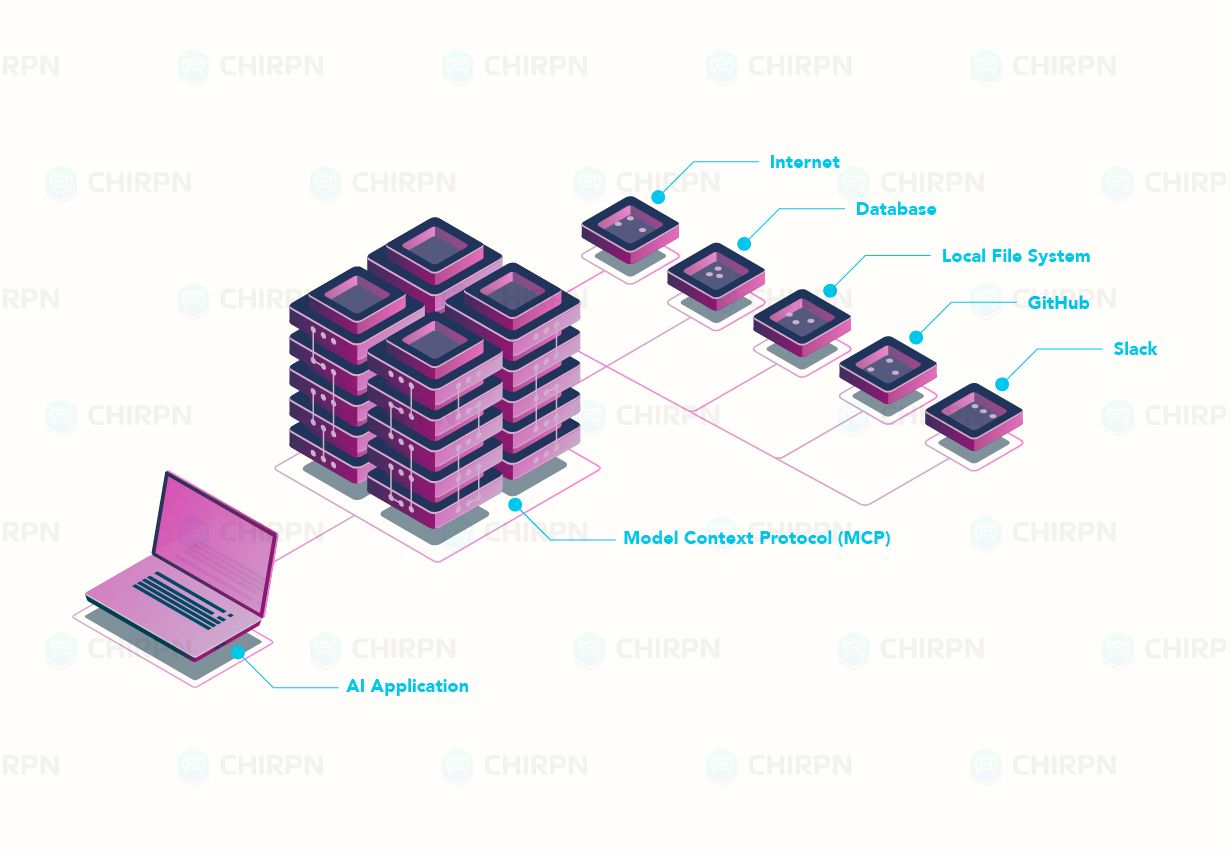
- MCP Servers – Act as adapters that expose your systems (databases, CRMs, files, SaaS platforms) through the MCP protocol. They make your data and tools accessible in a standard way.
- MCP Clients – Universal connectors that run inside your business applications. They translate what the application needs into MCP protocol requests.
- MCP Hosts – The environments where your teams work (CRM, IDE, desktop apps). These hosts rely on MCP clients to interact with your systems.
This setup allows AI agents to discover capabilities, access resources, and trigger actions without custom coding for every new integration.
How the MCP Protocol Works in Practice
Unlike REST, the MCP protocol is dynamic and context-aware. Here’s how it handles agent interactions:
- Dynamic capability discovery: Instead of relying on static API documentation, MCP servers tell agents what tools and resources are available in real time.
- Context preservation: Multi-step workflows maintain memory, so the agent can build on past actions instead of starting over.
- Intelligent error handling: Instead of failing with cryptic error codes, MCP allows agents to adjust when something goes wrong.
- Transport flexibility: Supports local connections for secure environments and remote connections for cloud systems.
Example: A CFO walks into a board meeting and asks their AI agent for the current financial performance.
- The MCP client connects to accounting, CRM, payroll, and banking systems.
- The MCP servers expose real-time data through a common interface.
- The agent aggregates the information, generates insights, and displays a live dashboard in under a minute.
The Business Impact of MCP
For businesses, the advantage of MCP isn’t abstract; it’s measurable. Companies using MCP-enabled systems see:
- Real-time visibility into financials, customer data, and operations
- Reduced reporting time by eliminating manual reconciliation
- Smarter AI agents that adapt without developer intervention
- Future-proof systems ready to integrate with next-gen applications
In practical terms, MCP makes the difference between an agent that just fetches data and an agent that helps your team make faster, better decisions.
Getting Started with MCP
If you’re evaluating MCP for your business, here are a few steps to take:
- Audit your current stack: Identify which applications, CRM, analytics, and customer support would benefit from AI agent access.
- Check vendor roadmaps: See whether your providers are building MCP protocol support. Forward-thinking vendors already are.
- Start small: Begin with a high-impact workflow, like customer support or financial reporting, before expanding across the organization.
The key shift is to stop asking “How do we build a better dashboard?” and start asking “How can an agent help us make better decisions in real time?”
The Model Context Protocol isn’t about memory; it’s the architecture that enables AI agents to interact with your systems intelligently. With MCP servers, MCP clients, and the MCP protocol, businesses can unlock context-aware, dynamic integrations that traditional APIs can’t handle.
The companies adopting MCP today are building the foundation for agent-driven operations. Those who wait may find their systems locked out of the agent ecosystem.
So, ask yourself: are your systems ready to connect with AI agents through MCP, or will they be left behind?
If you’d like a roadmap for MCP adoption in your business, let’s connect.