



A practical guide for CTOs and technology leaders ready to deploy multi-agent AI systems backed by proven AI software development services and framework.
45–90 Days: Chirpn MVP to Launch | 50+ AI Products Shipped | 40–60% Cycle Time Reduction (enterprise avg.) | 3–5x Throughput Gain in Code Review |
The experimentation window has been closed. By 2026, enterprise technology leaders cease to question the placement of agentic AI on their stack, and instead, they are questioning why it has not been released yet. And more and more, they are posing a follow-on question that is more pressing: what AI development company can bring them to production, within a short time, without six months of governance debt in such a project?
The solution does not lie in the company that has the most number of heads or the most glamorous research article. It is the company that has battle-proven AI software development services, proprietary methodology of quick deployment, and proven history of getting actual products to actual timelines. It is what an AI development company brings, and here is how we know how.
This is followed by an in-depth exploration of what thin-slicing AI really entails, why multi-agent architecture is the infrastructure choice of 2026, why every CTO needs to undertake five strategic moves currently, and how the AI development services provide the implementation advantage that can not be matched by an internal team - or even by the largest consultancy.
What Agentic AI Actually Is and Why It Changes Everything
The majority of the enterprise AIs implemented so far are reactive: a user issues a prompt, a model provides a response, and a human determines the course of action. The AI model is agentic in nature and the consequences of the enterprise productivity are significant.
A reactive model responds to an inquiry. An agent completes a job.
An AI agent refers to a system that cognizes the environment around it, formulates sub-goals, chooses tools, performs a series of real-world actions, and repeats this process until the resolution of a task is complete - the agent does not need to be signed by a human at each step. Agents are able to navigate the web, write and run code, query live databases, call out external APIs, draft and send communications, and spin off sub-agents to address parallel work streams.
"Agentic AI doesn't just assist -- it decides, acts, monitors outcomes, and self-corrects. For enterprises, this is the difference between a productivity tool and a productivity transformation."
This proficiency is what causes agentic systems to be qualitatively new to previous AI tooling. Identifying the appropriate AI app development company to design these systems is thus not a vendor choice, but a strategic infrastructure choice whose long-term compounding benefits are felt during the multi-year.
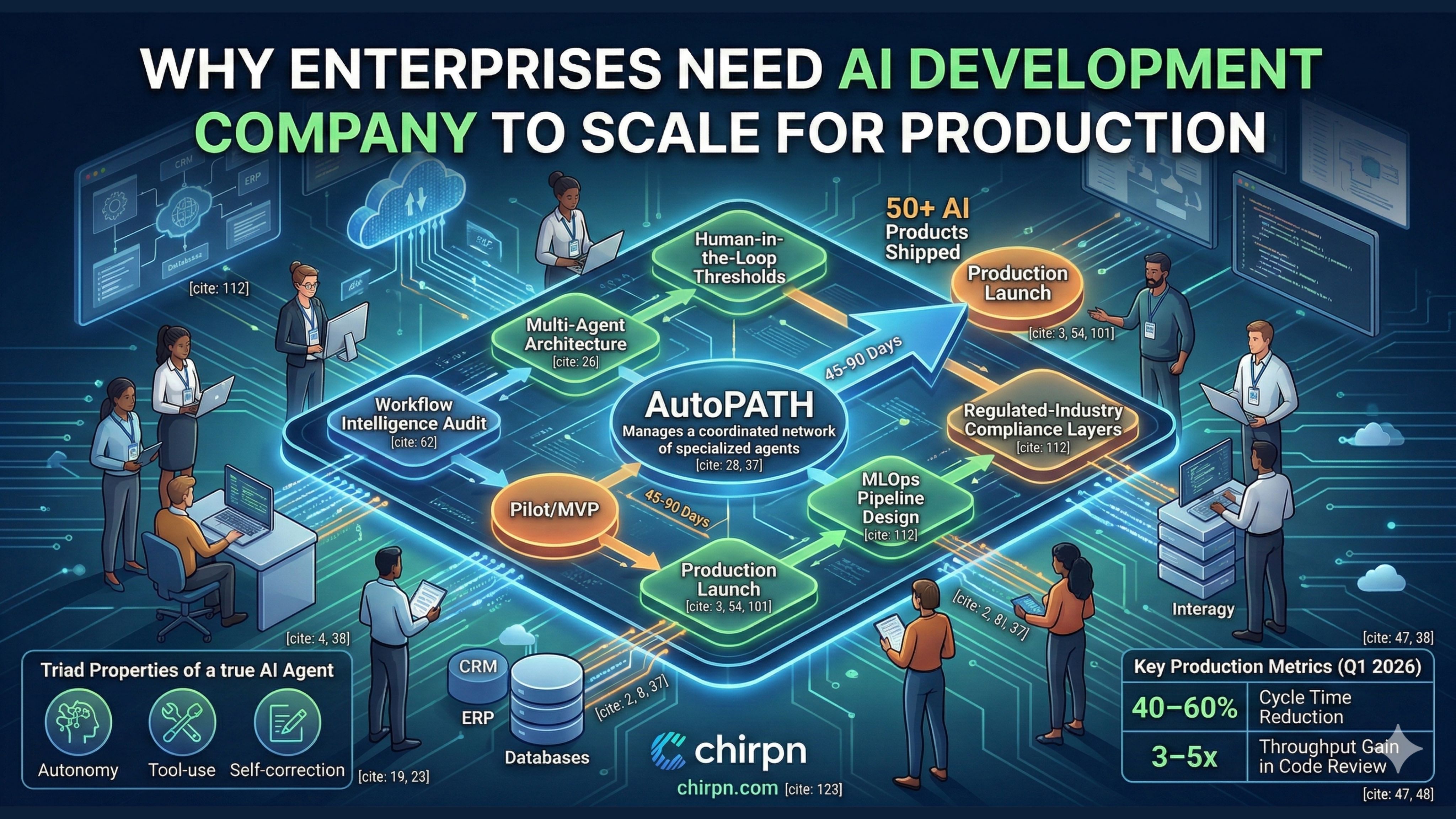
The Three Properties That Define a True AI Agent
Autonomy: the agent acts upon goals rather than commands - decides on a course of action to reach a set objective.
Tool-use: it does not only work with text, the agent manipulates real systems databases, APIs, browsers, code environments.
Self-correction: unlike a human agent which gives one output to human judgment, a self-corrected agent checks its own output quality and makes it over again.
The triad underpins the importance of this knowledge in assessing the providers of AI ml development services. A supplier of an AI automation product that fails to meet all three properties is providing an augmented scripting, not agentic AI. The framework is designed explicitly in terms of all three, hence the reason why delivered products by an AI software development company are shipped with autonomous agent loops as opposed to prompt chains.
Why Multi-Agent Architecture Is the Defining Infrastructure Decision of 2026
One AI agent managing a workflow in one direction is mighty. Transformational is a coordinated network of specialized agents operating simultaneously, and is the architecture that distinguishes production-grade AI systems and the advanced demos.
Multi-agent systems break down complex, long-horizon enterprise processes into paralleled tracks, which are run by agents that are optimized to their domain. Productivity ceiling moves away towards mono-tool performance to coordinated workflow intelligence.
Multi-agent systems do not simply automate things, they also automate coordination. This is what makes what used to take days in a few minutes.
Enterprise Use Cases Already Shipping in Production
| Workflow | Multi-Agent Architecture in Action |
| Deal Intelligence | Research agent + financial modelling agent + risk/compliance agent + synthesis agent running in parallel, completing in minutes |
| Customer Support | Triage agent + CRM update agent + escalation routing agent resolving Tier 1–2 cases autonomously |
| Software Engineering | Planning agent + coding agent + testing agent + deployment agent coordinating across the full SDLC |
| Financial Reporting | Data ingestion agent + reconciliation agent + narrative generation agent + audit trail agent |
| Supply Chain | Anomaly detection agent + scenario modelling agent + procurement action agent closing the loop without human relay |
All these processes demand an AI software development company that is able to design agent orchestration layers, not merely execute model API calls. In this level of architecture, the machine learning development services offered by an top AI development company are distinguished in comparison to the commodity AI integration companies.
The framework designed exactly to work with this complexity - an tested, proven framework to design multi-agent systems, integrate tools, manage memory, and even inter-agent communication starting the first day of an engagement.
Why 2026 Is the Deployment Year — and the Cost of Waiting
Enterprise agentic AI has been shifting to operationally inevitable in 2026 through the convergence of three forces of interest. The organizations that are still in their pilot stage are not only losing opportunity, they are taking on competitive debt that is adding quarter after quarter.
Force 1: The Maturity of Infrastructure is Here.
This bottom layer is now stable. Model quality can be used to assist production-grade reasoning when faced with multi-step and complex problems. Tool-calling APIs are standardized. Agents orchestration systems LangGraph, AutoGen, CrewAI have been through early-adopter phases and are enterprise-ready. Hyperscalers provide SLA guaranteed managed agent runtimes. The delay argument on the technical risk is dead.
Force 2: The Labor Economics Have Moved.
Continued shortage of knowledge workers in high-skill areas such as legal analysis, software engineering, financial compliance has rendered the expense of failing to deploy agents quantifiable and tangible. The early adopters of the enterprise are claiming 40-60 percent reductions in cycle time on document-intensive processes and 3-5x-throughput in code review pipelines. These are not forecasts, they are just Q1 2026 operating figures.
Force 3: AI Deployment Velocity Has become a Signal to the Board.
The pace of AI deployment is a competitive measure followed by investors and boards by Q1 2026. Whether to develop AI capacity is no longer a question, now it is whether your schedule is so fast that it counts. That is where the choice of the appropriate AI development company would be a direct input to the enterprise valuation.
Waiting to have more certainty is the most costly choice that a CTO can make in 2026. The infrastructure is ready. The economics are clear. The other variables are organizational - and these are solvable.
The reason that the AI Orchestrated SDLC framework has enabled us to have the 4590 day MVP-to-launch history on 50+ AI products is also because the organizational drag that slows agentic AI deployments is removed by the AI Orchestrated SDLC framework. Anytime you take a software development company powered by AI as your AI software development company, governance, architecture, and delivery are designed the day one - not added afterwards when a pilot fails.
Five Strategic Moves for Enterprise CTOs in 2026
The next actions would part organizations that will reap the productivity advantages of agentic AI with those who will be arguing about frameworks in 2026. At each step, we come out on the side where AI development services are directively, quantifiably adding value.
Move 1- Audit Your Agent-Ready Portfolio.
Not all of the workflows can be suited for early agentic automation. Emphasize high-frequency, rule-bound on the edges and judgment-intensive in the middle, at present relying on the coordination of knowledge workers, and quantifiable in terms of the quality of the output. High-signal candidates are document processing, research synthesis, code review, and multi-system data reconciliation.
Role of AI Development Company: Within every engagement of AI M development services focused, a true AI development company will be involved in an initial Workflow Intelligence Audit - understanding client processes in terms of their alignment with agent-readiness standards and estimating their opportunity to be automated in terms of value and viability. This is instead of months of internal discussions and is provided as a deployment roadmap.
Move 2 - Have Agent Governance Framework in Place Before You Deploy.
Placing agents in place ungoverned is a technical and reputational risk in a hurry. Set limits on decision authority: what must be approved by a human, what is allowed to be permitted by a tool, what audit trail must be met in a regulated environment. Governance infrastructures constructed in advance of deployment are significantly less expensive than infrastructures constructed in response to an incident.
Role of AI Development Company: Agentic AI system is default-equipped with a configurable governance layer, such as human-in-the-loop thresholds, permission scoping, generation of audit trails and routing of escalation are all part of the standard architecture, not an appendix. These patterns of governance have been optimized in our AI chatbot development company in the healthcare, financial services, and broadcasting clients.
Move 3 - Treat Agent Orchestration as Core Infrastructure
Agent orchestration - The layer that handles agent creation, access to tools, memory and inter agent communication is becoming as basic as your cloud configuration layer. Test orchestration platforms as rigorously as cloud vendor choice: reliability, observability, economics of one task, and compatibility with existing security architecture.
Role of AI Development Company: The AI orchestrated SDLC platform offers an enterprise quality orchestration layer that has been proven to work in 50+ full infrastructure production deployments. Instead of developing orchestration manually - a 3-6 months engineering project - customers are given an existing architecture and customize it to their workflow environment. This is the main benefit in dealing with a specialist AI software development company instead of making generic parts in-house.
Move 4 Reskill Your Technical Workforce to Develop Agents.
The most significant deployment bottleneck of most enterprises at the moment is the skills gap in agentic AI development. Immediate engineering, agent architecture design, assessment structures, and tool integration are not the conventional competencies of ML engineering or software development. The market of external talents of these skills is highly constrained and it will continue to be so in 2027.
Role of AI Development Company: A proactive Capacity POD model that integrates AI engineers of senior level into client teams - balancing offshore cost-saving and onshore strategy alignment. This model shifts the development knowledge of agentic development to internal teams throughout the engagement lifecycle as opposed to establishing permanent dependency on the vendor. It is the machine learning development services that develop internal capability rather than provide the outputs.
Move 5 - Be Explicit on Your Human-in-the-Loop Policy.
The human oversight policy has been most expensive in terms of errors in early agentic AI applications. Specify prior to implementation: what types of tasks must not be acted upon without human inspection, what is the confidence level above which causes an escalation, how the agents are expected to respond upon meeting some ambiguity beyond their authorized area. Transparency in this case will speed up implementation since it eliminates the drag of governance that slows down the majority of enterprise pilots.
Role of AI Development Company: The process of discovery of each agentic engagement by AI development company entails a Human-in-the-Loop Policy Workshop - a formal procedure that delivers an explicit decision matrix that regulates the degree of agent autonomy pertinent to workflow categories. This document is a living specification which regulates the behaviour of the system and makes governance audit easier in the future.
The Risks That Demand Engineering Attention and How to Manage Them
The issue of agentic AI brings a new qualitative type of risk that has not existed previously in deploying AI. Due to the fact that agents actually operate in the real world and not just produce outputs, the blast radius of error is greater and more rapid. None of these risks are disqualifying - all of them can be handled with the appropriate architecture. This is the strategic error of regarding them as causes to slow down and not as challenges to design around.
| Risk | Mitigation Architecture |
| Cascading pipeline failures | Agent output validation gates between pipeline stages; confidence-threshold routing to human review before downstream propagation |
| Prompt injection attacks | Input sanitisation layers, constrained tool permission scoping, and sandboxed execution environments for code-running agents |
| Runtime scope creep | Explicit action permission lists per agent role; immutable system prompt enforcement; action logging with real-time anomaly detection |
| Audit trail gaps | Append-only action logs with cryptographic timestamping; per-action human-readable rationale generation for regulated workflow contexts |
An AI app development company has honed these mitigation architectures in clients in regulated industries such as healthcare providers, financial services firms, as well as broadcasting operations. Every architecture pattern is integrated into the AI Orchestrated SDLC framework in the form of a configurable default - i.e. clients have battle-tested risk controls available to them, on the very first day that they are deployed.
Why Chirpn Is the AI Development Company Built for This Moment
The AI software development service market is saturated. Enterprise giants are deploying billions in AI platforms but cater to another type of market, which is large-enterprise, long-cycle, and multi-year engagements with the price tags to reflect. Competition between boutique peers is based on cost but does not involve proprietary methodology. Chirpn is strategically placed: a start-up AI software company with enterprise-level performance at mid-market speed and cost.
45–90d MVP to Production | 50+ AI Products Launched | 162 Senior Engineers & AI Specialists | 10+ Regulated-Industry Clients |
The Question of What Makes Chirpn Different as an AI Development Company.
- AutoPATH / AutoPATH Framework: The SDLC that Chirpn has developed as proprietary AI-orchestrated SDLC is the power behind the 45-90 day launch roadmap. It does not constitute a marketing assertion - it is a documented architecture that has been used in 50+ production deployments, in the design of agent architecture, orchestration layer design, tool integration, testing, and governance.
- AI-First, not AI-Retrofit: As opposed to other consultancies that introduced AI practices to existing services, Chirpn was established as an AI-first organisation. All service pillars such as AI chatbot development and machine learning development services through to cloud modernisation and legacy system transformation all are based on AI-native delivery.
- Regulated-Industry Track Record: Healthcare AR training applications, financial analytics dashboards, broadcasting CRM systems, and sports tech real-time APIs - Chirpn has a record of production delivery agentic and AI-connected in situations where governance, performance, and reliability cannot be compromised.
- Capacity POD Model of Embedded Delivery: The offshore-onshore POD model would enable Chirpn to offer the economics of an offshore-onshore partnership to develop high-quality AI ml services at a boutique cost base - which is to offer high-quality AI ml development services to mid-market and growth-stage businesses that cannot afford enterprise consultancy rates.
- Australian and US Mid-Market Specialisation: Chirpn has markets that are underserved by enterprise giants - Australian mid-market, growth-stage contemporary US companies and international businesses that need to transform at a rapid pace without engagement cycles of 18 months.
| "Choosing Chirpn as your AI software development company means inheriting a proven production framework, not funding the development of one." |
Chirpn's Core AI Service Lines
| Service | Capability Detail |
| AI Software Development Services | End-to-end AI product engineering: architecture, development, testing, deployment, and post-launch optimisation using the AutoPATH framework |
| AI ML Development Services | Custom machine learning model development, MLOps pipeline design, model evaluation, fine-tuning, and production deployment |
| AI Chatbot Development Company | Enterprise-grade conversational AI: LLM-powered chatbots with tool use, CRM integration, escalation routing, and regulated-industry compliance layers |
| AI App Development Company | Full-stack AI-native mobile and web application development from GenAI-integrated consumer apps to internal enterprise workflow tools |
| Machine Learning Development Services | Predictive analytics, recommendation engines, NLP pipelines, computer vision applications, and agentic ML workflow orchestration |
| Data & Analytics | End-to-end data infrastructure: collection, storage, modelling, visualisation (Tableau, Power BI, D3.js), and AI-driven insight generation |
| Cloud AI Infrastructure | AWS, Azure, and GCP architecture and migration, with managed agent runtimes, vector database integration, and AI-optimised cloud cost management |
| Legacy Modernisation with AI | AI-integrated refactoring and modernisation of legacy technology stacks compressing multi-year modernisation programmes into focused 6–12 month delivery tracks |
Conclusion
Agentic AI not the end of technology roadmap capability in the future. It is a present capability of production at an increasing number of businesses - businesses which are now consolidating a structural productivity edge that will become more and more challenging to wipe out by late entrants.
The organisations which contracted the right AI development company in 2025 are not only ahead of deployment they are ahead of institutional knowledge, agent governance maturity, workflow data and agent performance baselines. Any quarter of delay is another quarter of compounding advantage loss to competitors who acted.
There are other variables not technical between your organisation and an agentic AI system deployed. Its infrastructure is developed. The frameworks are proven. The economics are clear. The variables are organisational - and it is the variables that the AI software development service services of Chirpn are specifically aimed to address: quick architecture decision-making, embedded governance, quick delivery through AutoPATH and an engineering team that has already launched 50+ AI products and more.
| The most expensive decision a CTO can make in 2026 is to wait for more certainty. Partner with an AI development company that has already delivered certainty — through working production systems. |
Chirpn is the AI development company that takes you to production in 4590 days - not 18 months. You need AI ml development services to make a machine learning pipeline or an AI chatbot development company to create an enterprise-grade conversational agent or an end-to-end AI app development company to roll out your next AI-native product, Chirpn AutoPATH framework and 50+ product track record will be the deployment advantage your competitors are gaining against.