



What Is an AI-Orchestrated SDLC?
An AI orchestrated SDLC is one where autonomous agents coordinate every phase of the ai software development lifecycle simultaneously is no longer a research concept. PwC's 2026 Agentic SDLC research documents the shift as a mainstream trajectory: GenAI has moved into the core of software delivery, accelerating both speed and quality across the organizations that have adopted it. The firms that have rebuilt their delivery around this architecture are shipping production AI products in weeks rather than months.
This guide explains what an AI-orchestrated SDLC is, why sequential delivery now costs more than it saves, how the AutoPATH framework implements the architecture phase by phase, and what the delivery data shows.
What Is an AI-Orchestrated SDLC?
An AI orchestrated SDLC is a software development lifecycle where autonomous AI agents plan, develop, test, and deploy software in a coordinated, parallel workflow rather than handing work between human specialists at each phase boundary.
The term distinguishes this model from AI SDLC automation at the tool level, in which AI tools help individual developers work faster inside phases that still run sequentially. AI orchestration is a different architectural layer: it coordinates the transitions between phases, maintains context across them, and eliminates the inter-phase waiting that accounts for as much elapsed time as the work itself.
PwC's responsible AI in the SDLC report confirms that companies leveraging AI throughout the SDLC are realising measurable gains across delivery, quality, and ROI and that the shift from fragmented tools to orchestrated, agent-driven workflows is where that value concentrates.
Why Sequential SDLC Is Now the Expensive Option
Sequential SDLC was a rational response to expensive iteration. When changing a requirement in week four cost as much as changing it in week one, sequential gates and heavyweight documentation made sense. AI has inverted that economics.
McKinsey State of AI 2025 finds that AI-assisted developers complete significantly more routine tasks per session but the primary source of time loss in a sequential SDLC is not slow coding. It is context loss at every hand-off: the time a new specialist spends re-acquiring the context the previous one held. An AI assisted SDLC that merely adds tools within phases does not solve this problem; only orchestrating the transitions does.
In a traditional project, a senior engineer wastes approximately 40% of their time on tasks that AI can perform boilerplate code, routine test generation, documentation, deployment configuration. AutoPATH routes those tasks to AI agents, concentrating engineering effort where human judgment adds the most value.
What Is AutoPATH?
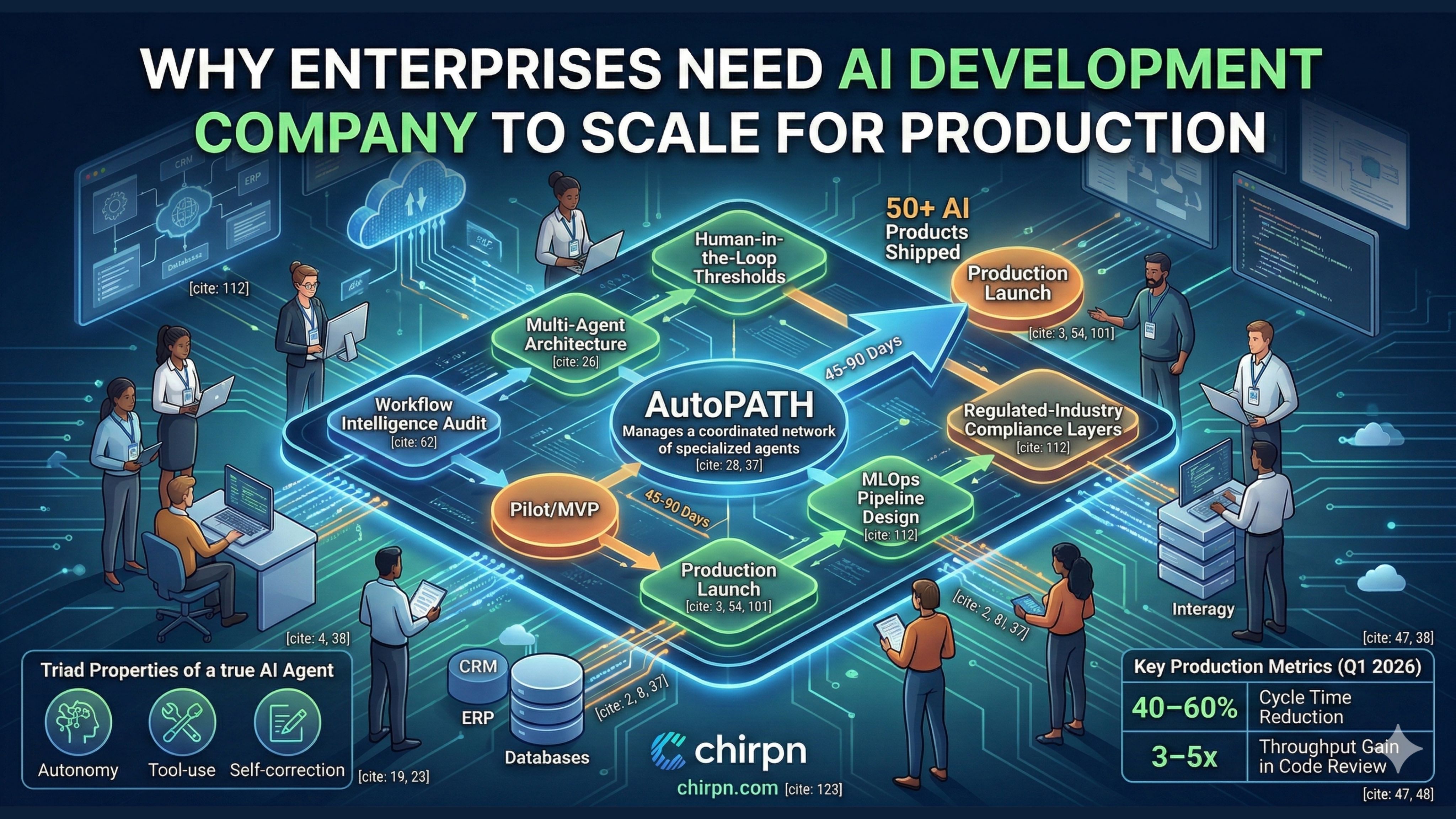
The AutoPATH framework is Chirpn's AI-orchestrated SDLC implementation. It is not a tool, it is a framework that coordinates multiple AI systems: a requirements analysis agent, a design and prototyping agent, a code generation layer, an automated testing system, and a deployment pipeline all running in parallel rather than in sequence. The name reflects the overall purpose: a fully automated, AI-guided path from client brief to production deployment.
100+ products and platforms have been delivered on the AutoPATH framework. The delivery timeline from signed contract to production is 45–60 days for scopes that take conventional delivery 3–6 months. AutoPATH is the pillar of Chirpn's Rapid Launch program.
How AutoPATH Works: Phase by Phase
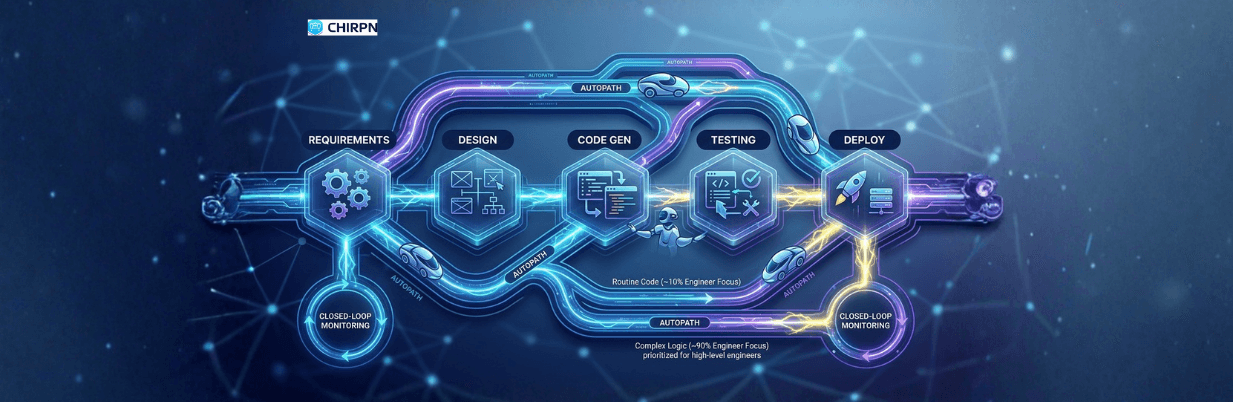
The AutoPATH framework covers the full ai software development lifecycle in five parallel workstreams. Each phase hands its output to the next in directly consumable form, no re-formatting queue, no context loss at the boundary.
Phase 1 Requirements Analysis
The AutoPATH requirements agent accepts unstructured input documents, meeting notes, Confluence pages, or raw voice recordings and produces an organised, prioritised backlog with acceptance criteria, edge cases, and dependency flags.
In conventional delivery, a business analyst takes 1–3 weeks to translate stakeholder inputs into actionable specifications. AutoPATH produces that output in hours. The product is not a rough draft, it is an engineering-ready specification that the design and code generation agents consume directly.
Phase 2 Design and Prototyping
AutoPATH generates UI prototypes and system architecture recommendations from the requirements output. Within the first 72 hours of an engagement, teams have an interactive prototype for stakeholder review not a static mockup, but a representation of the real data model, user flows, and key integration points the development team will implement. This AI SDLC automation of the design phase runs concurrently with the tail end of requirements, so misalignment is caught in hours rather than weeks.
AutoCAR, Chirpn's rapid-prototyping companion tool, generates interactive prototypes for end-user review before production code begins using the same Vertex AI and Google AgentSpace infrastructure that underpins the full AutoPATH framework.
Phase 3 Code Generation
The code generation layer of AutoPATH generates the repeatable portion of any software build: authentication, state management, CRUD operations, API wiring, configuration, and standard integration patterns. This is the commodity code that consumes a significant proportion of engineering time in conventional projects time that AutoPATH routes to AI agents so engineers concentrate on the differentiated business logic.
GitHub's Octoverse 2024 report confirms that AI-assisted code tools boost average developer throughput by 55%. AutoPATH applies this systematically across the commodity stages of the build, compounding the gain across the full project scope rather than at the level of individual developer sessions.
Phase 4 Testing
AutoPATH generates test scenarios, test cases, and coverage plans before a line of production code is written. QA does not wait for development to complete; it begins in parallel and is ready to run the moment the first component ships. The result is 80–90% test coverage as a structural output of the AutoPATH framework, rather than the 40–60% industry average that conventional, retrospective QA produces.
Atlassian's Rovo Dev 2026 research (published April 2026, ICSE 2026 recognised) found that AI code review reduced PR cycle time by 30.8% and that 38.7% of AI agent comments during code reviews contributed to further code fixes a signal that AI-generated review catches meaningful issues rather than surface-level style violations.
Phase 5 Deployment
AutoPATH runs an automated deployment pipeline configured during the build not assembled under go-live pressure after development completes. Infrastructure provisioning, environment configuration, and rollout sequencing are generated alongside the product, so deployment artefacts are ready the moment QA clears.
Post-deployment monitoring feeds directly back into the requirements pipeline. Production behaviour performance metrics, error rates, user flow data informs the next task breakdown in the requirements agent, creating a continuous improvement loop rather than a one-way delivery handoff.
AI-Orchestrated SDLC vs Traditional SDLC: The Numbers
The comparison below represents Chirpn's delivery data across AutoPATH and pre-AutoPATH traditional projects. These are delivery measurements, not projected estimates.
| Metric | Traditional SDLC | AI-Orchestrated SDLC (AutoPATH) |
| Elapsed time (comparable scope) | 3–6 months | 45–60 days |
| Requirements phase | 1–3 weeks of workshops and alignment cycles | Hours AI generates executable specification from structured brief |
| Design phase | 1–3 weeks; sequential gate before engineering begins | Runs concurrently; engineering-compatible artefacts generated directly |
| Test coverage | 40–60% industry average; test creation lags development | 80–90% structural coverage generated in parallel with development |
| Deployment | Manual pipeline configuration after development completes | Automated pipeline generated during build; artefacts ready at QA completion |
| Post-launch monitoring | Separate setup; production behaviour rarely feeds back into requirements | Monitoring feeds directly into the requirements pipeline for the next cycle |
Who Gains the Most from an AI-Orchestrated SDLC?
Growth-stage SaaS companies developing their first AI-native product or re-platforming an existing product. An AI orchestrated SDLC with a 45–60 day delivery is designed for exactly this stage speed to production is the primary constraint.
Mid-market companies ($10M–$200M ARR) with a technology backlog they cannot clear with their current staffing. AutoPATH's Capacity POD model deploys a senior team into the existing engineering structure, extending the ai software development lifecycle discipline without requiring a wholesale process change.
Google Cloud clients building on Vertex AI or AgentSpace. AutoCAR, the prototyping companion to AutoPATH, uses the same infrastructure as Google's own agentic products confirmed on Chirpn's Google Cloud partnership page.
Healthcare and EdTech companies with compliance requirements. AutoPATH generates documentation at each phase, traceability, test evidence, deployment records which is the documentation structure that HIPAA, GDPR, and similar frameworks require.
Why AutoPATH Is Different from AI-Assisted Development Tools
Most AI development tools operate at the level of the individual developer, a coding assistant that helps one engineer write faster inside a phase that still runs sequentially. That is an AI assisted SDLC approach. The AutoPATH framework operates at the SDLC level: it coordinates transitions between phases, maintains context across them, and compresses the inter-phase waiting that accounts for as much elapsed time as the work itself.
Consistency: Because AI coordinates the entire lifecycle, all projects generate identical documentation structure, the same test coverage baseline, and the same deployment pipeline format. Quality does not depend on which engineer is assigned.
Speed at scope: A single developer using a coding assistant gets faster inside one phase. A team running AutoPATH compresses the full project timeline requirements, design, development, QA, and deployment simultaneously.
Knowledge retention: AutoPATH generates lifecycle documentation throughout the build. When an engagement ends, the client receives not only working software but a complete record of every requirement, design decision, test result, and deployment action.
How to Get Started with AutoPATH
Rapid Launch: a fixed-price 45–60 day engagement running the AutoPATH framework across all five phases from day one. Designed for businesses that need a production AI product on a startup's timeline.
Capacity POD: a dedicated senior team backend architect, frontend engineer, QA engineer, DevOps deployed into the client's existing engineering structure under AutoPATH's coordination layer.
Both models operate on Chirpn's Australia–US–India delivery platform. Google Cloud Partner credentials (Vertex AI, AgentSpace, Agent Assist, Gemini) apply across both. Full IP transfers to the client on delivery. No licence fees. No lock-in.
Ready to scope your build? Book a free discovery session.
Conclusion
The shift to an AI orchestrated SDLC is not a productivity improvement on top of conventional delivery, it is a different architecture for how software gets built. Sequential phases with specialist hand-offs made sense when iteration was expensive. In 2026, the dominant cost is context loss at each boundary, and AutoPATH eliminates that cost by running all five phases in parallel under AI coordination.
Frequently Asked Questions
What is an AI-orchestrated SDLC?
An AI orchestrated SDLC uses autonomous AI agents to coordinate all phases of the software development lifecycle simultaneously with requirements, design, code generation, QA, and deployment rather than running them sequentially with human specialists handling work between phases. The key gain is eliminating inter-phase waiting and context loss, which accounts for as much elapsed time as the development work itself.
How is AutoPATH different from GitHub Copilot or other AI coding tools?
GitHub Copilot and similar tools represent an AI assisted SDLC approach; they make individual developers faster inside a single phase (coding). The AutoPATH framework coordinates AI agents across all five SDLC phases simultaneously, maintaining context across every transition. A developer using Copilot gets faster at writing code; a team using AutoPATH compresses the full project timeline from 3–6 months to 45–60 days.
What test coverage does AutoPATH produce?
80–90% test coverage as a structural output of AI SDLC automation generated in parallel with development rather than retrospectively after code is complete. The industry average for conventional, sequential QA is 40–60%.
What types of companies benefit most from AutoPATH?
Growth-stage SaaS companies building their first AI-native product, mid-market businesses with a technology backlog, Google Cloud clients building on Vertex AI or AgentSpace, and healthcare and EdTech companies with compliance documentation requirements. Any organisation that needs a faster, more consistent ai software development lifecycle without the overhead of a Tier-1 IT major.
How do I get started with AutoPATH?
Two entry points: Rapid Launch (45–60 day fixed-price engagement using the AutoPATH framework across all five phases from day one) and Capacity POD (dedicated senior team deployed under AutoPATH coordination). Both are available via a free 30-minute discovery session at chirpn.com/contact-us/.