



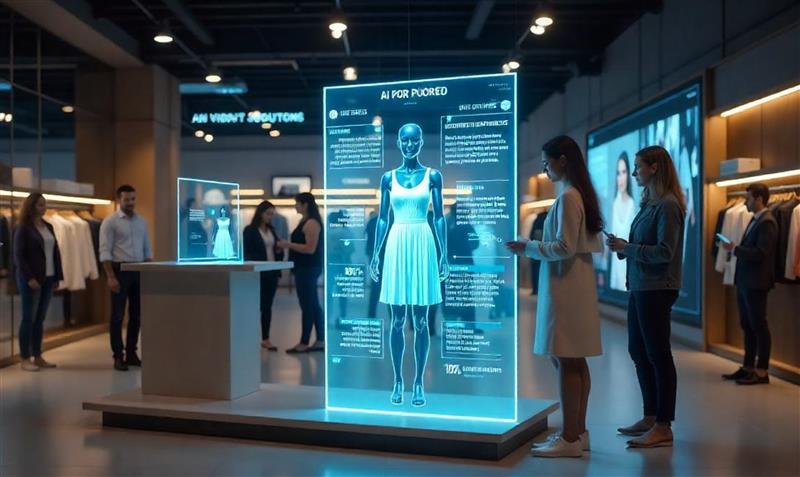

The retail industry is facing compounding pressure: unpredictable consumer demand, inventory volatility, rising fulfillment costs, and a customer experience bar set by digital-native competitors who have operated with AI since day one. Facing these severe retail industry challenges, retail inflation challenges, and consumer demand unpredictability, McKinsey estimates that generative AI in retail could generate $400–$660 billion in value annually across retail and consumer packaged goods making AI in retail the highest-value sector for AI deployment outside financial services.
The firms that will own the next decade of retail are not the ones that have the largest AI budgets. They are the ones that move now, driving real AI transformation in retail and sustainable retail growth through backend operations optimization. Generative AI capabilities that take 18 months to implement today will take 36 months once competitors have the same idea and the same vendors are backlogged. First-mover advantage in AI is real, measurable, and time-limited.
Adopting AI-driven business growth models enables a true AI-powered customer experience, setting the stage for long-term retail innovation.
The AI Advantage: Five Capabilities Reshaping Retail
1. Hyper-Personalization at Scale
McKinsey's personalisation research finds that 76% of consumers are more likely to purchase from brands that personalize, and companies that excel at hyper-personalization generate 40% more revenue than average players. Generative AI moves this from A/B-tested segments to individual-level adaptation: creating personalized customer experiences through customer preference analysis, browsing history analysis, and purchase history insights. These AI-driven recommendations, contextual AI marketing, and smart AI in CRM foster lasting brand loyalty through AI, adjusting in real time to each customer's behaviour at a scale no manual process can match.
Stitch Fix is the widely cited industry example: its AI styling system documented in its 2023 Annual Report and engineering blog uses ML models to match clothing items to individual customers based on style profile, fit history, and price sensitivity, enabling a personalization model that could not be replicated by human stylists at its scale.
2. Demand Forecasting and Inventory Optimization
Inventory management in retail is where the cost of getting AI wrong is most visible and most immediate: overstock ties up working capital; stockouts lose sales and damage brand trust. Implementing demand forecasting with AI, predictive analytics in retail, and inventory optimization allows modern retailers to achieve precision. Generative AI demand models incorporate variables weather, social trends, competitor pricing, promotional calendars that conventional statistical forecasting cannot handle at the required granularity.
By using advanced AI demand prediction, synthetic data simulation, and market scenario analysis, companies strengthen strategic decision making with AI for overall retail efficiency improvement.
Macy's has publicly described its use of AI demand forecasting to reduce markdowns and improve in-season replenishment accuracy, as reported in NRF's coverage of Macy's technology transformation. The operative principle using AI to predict what customers will want before they search for it is the same regardless of retailer scale.
3. Dynamic Product Descriptions and Content Generation
In digital-first retail, product content is the primary sales mechanism. Generative AI creates digital product descriptions, category copy, and marketing content tailored to the reader's context, their search intent, browsing history, and device. Utilizing AI-generated content, dynamic product descriptions, and personalized product descriptions leads directly to a customer engagement increase, click-through rate improvement, better product discoverability, and conversion optimization. A product page that reads differently for a first-time visitor searching broadly and a returning customer browsing a specific category is not a future capability; it is deployable today.
The operational benefit beyond conversion rate is cost: generating product descriptions at catalogue scale, across multiple languages and formats, eliminates a significant portion of content team overhead while improving consistency.
4. Conversational Commerce and AI Customer Support
Gartner predicts that agentic AI will autonomously resolve 80% of common customer service issues without human intervention by 2029, reducing operational costs by 30%. Deploying AI chatbots in retail, AI virtual assistants, and conversational AI enables seamless customer support automation, personalized shopping assistance, chatbot recommendations, and AI-driven customer interactions. In retail where Tier-1 queries (order status, return initiation, size guidance) are high-volume and highly predictable this is achievable materially faster.
Starbucks' Deep Brew AI platform documented in Harvard Business School case coverage personalizes drink recommendations, predicts equipment maintenance needs, and manages store-level inventory, demonstrating that AI-powered customer interaction at retail scale is operational, not aspirational.
5. Unified Omnichannel Experience
Generative AI connects the signals from a customer's online browsing, in-store behavior, mobile app usage, and purchase history into a single coherent profile and uses that profile to power an omnichannel retail experience and a comprehensive AI omnichannel strategy. Through online to offline integration, future-focused AR VR retail experiences, and an immersive shopping experience, brands deliver real-time personalization that reinforces customer retention strategies, data-driven personalization, and retail customer satisfaction across every touchpoint. A customer who browses a coat online, tries it in-store, and then receives a targeted promotion for a matching item on their phone is experiencing the kind of contextual continuity that generative AI makes operationally viable at scale.
The infrastructure requirement is significant: a unified data layer connecting e-commerce, POS, loyalty, and fulfilment systems. But that infrastructure investment is the same one required for any serious AI program and once built, it enables every other capability on this list.
Challenges of Generative AI in Retail
Navigating AI adoption challenges requires addressing data privacy in AI, ethical AI use, and strict AI infrastructure requirements from day one.
Data privacy and consent. Personalization at the individual level requires individual-level data. In jurisdictions with GDPR, CCPA, and equivalent frameworks, the consent and data minimization requirements create constraints on what models can be trained on and how long data can be retained. Retailers building AI systems in 2026 are designing for these constraints from the architecture stage, not retrofitting compliance after deployment.
Algorithmic bias and fairness. Recommendation systems can systematically show certain products to certain demographic segments in ways that were not intentional but that create reputational and regulatory risk. Bias auditing evaluating model outputs across customer segments before deployment is a requirement for any retailer with a significant customer base, not a nice-to-have.
Infrastructure readiness. Most retailers' data does not exist in a form that AI models can use directly. Fragmented POS systems, disconnected e-commerce platforms, and loyalty programs that don't communicate with inventory systems are the norm, not the exception. The AI deployment timeline is almost always determined by how long the data infrastructure work takes not the model development.
Change management. The operational and cultural changes required to integrate AI into buying, merchandising, and customer service workflows are as large as the technical ones. Retailers that treat AI as a technology project rather than an operating model change consistently take longer to reach commercial results than those that address workforce change in parallel with system implementation.
The Future of Generative AI in Retail
Understanding the future of retail AI and predictive retail analytics helps businesses navigate the evolving marketplace.
The trajectory is clear. Generative AI in retail will move from individual use-case deployments toward integrated AI operating layers that span the entire commercial cycle: demand sensing to fulfillment, customer acquisition to retention, supplier negotiation to delivery promise. The retailers that are already integrating AI into their core operations will have compounding data advantages over competitors who are still evaluating.
Three capabilities will define retail AI leadership in 2027–2028: real-time demand shaping (AI that influences what customers want, not just responds to it), autonomous supplier negotiation (agentic AI negotiating replenishment terms based on real-time inventory and demand signals), and physical-digital integration (AI that connects in-store sensor data, shelf inventory, and digital customer profiles in real time). Each requires the data infrastructure investment that first-movers are making now. McKinsey's retail AI analysis estimates the total annual value opportunity at $400–$660 billion and most of it sits in capabilities that have not yet been widely deployed.
How Chirpn Approaches Retail AI
Retail is not one of Chirpn's current cleared client verticals, so we will not claim retail case studies we do not have. What we can offer is the delivery architecture: AutoPATH, our AI-orchestrated SDLC, is how we build AI-native products in 45–60 days across any vertical including the data pipeline work, LLM integration, recommendation system engineering, and post-launch monitoring that retail AI deployments require.
The infrastructure pattern for retail AI, a unified data layer connecting e-commerce, POS, loyalty, and fulfillment, is the same integration challenge we solve for healthcare and EdTech clients: connecting systems that were built separately and need to share data in real time. That problem does not change industry to industry; the domain-specific model on top of it does.
If you are a retailer evaluating a generative AI program and want to understand the delivery architecture, the data readiness requirements, and realistic timelines, we can scope that in a 30-minute session without a sales presentation.
Book a free discovery session chirpn.com/contact-us/
Conclusion
Generative AI in retail is no longer a pilot program question. The capabilities exist, the ROI cases have been documented at scale, and the infrastructure required to deploy them is well-understood. The remaining question is execution: which retailers will have the data infrastructure, governance frameworks, and delivery partners to move from evaluation to production in 2026 and which will still be in discovery in 2028, watching competitors compound their advantage.
The first-mover advantage in retail AI is not about having a larger budget. It is about making the infrastructure investment earlier, choosing delivery partners who have solved the data readiness problem before, and treating AI as an operating model change rather than a technology project. That combination is available to any retailer today. The window is narrowing.
Frequently Asked Questions
What is generative AI in retail?
Generative AI in retail uses machine learning models trained on large datasets to create new content and predictions, personalized product recommendations, demand forecasts, product descriptions, and customer service responses. Unlike conventional rule-based systems, generative AI adapts to new inputs and improves with more data, making it particularly suited to the variability and scale of modern retail operations.
What are the biggest benefits of generative AI for retailers?
Five capabilities with measurable commercial impact: hyper-personalization (McKinsey finds personalization leaders generate 40% more revenue than average); demand forecasting that reduces stockouts and overstock simultaneously; AI-generated product content at catalogue scale; AI customer service that handles Tier-1 queries autonomously; and omnichannel data integration that creates consistent customer experiences across digital and physical touchpoints.
What are the main challenges of implementing retail AI?
Data infrastructure is almost always the binding constraint most retailers' data is fragmented across disconnected systems and needs significant preparation before AI models can use it. Beyond infrastructure: data privacy compliance (GDPR, CCPA), algorithmic bias auditing, and the change management required to integrate AI into buying, merchandising, and customer service workflows.
How long does it take to implement generative AI in retail?
A focused proof-of-concept on a single use case personalized recommendations or AI customer support typically takes 4–8 weeks with the right delivery partner. A production deployment integrated with core retail systems (POS, e-commerce, loyalty, inventory) takes 3–6 months. The timeline is almost always determined by data readiness rather than model development retailers with clean, connected data move materially faster.
What should retailers look for in an AI development partner?
Five things: experience with retail-adjacent data integration (POS, e-commerce, CRM, loyalty systems); a data readiness process that happens before any delivery commitment; post-launch monitoring and model drift management included in scope; milestone-based commercial terms; and named production deployments you can verify by speaking to a reference client. A firm that cannot show you a production retail AI system or a production system in a closely adjacent domain has not solved the hard part.