



Banner Background

List of Best AI Companies in India – 2026

  • Category

    Consumer

  • Chirpn IT Solutions

    AI First Technology Services & Solutions Company

  • Date

    April 28, 2026

Why This List Matters in 2026

India now accounts for 16% of the global talent pool in AI - only the US has more. The nation's AI market is set to surpass $17 billion by 2027 by Boston Consulting Group and IBEF projections (and by Fortune Business Insights, it will reach $130 billion by 2032, growing at 39% annually). The IndiaAI Mission, with a government corpus of ₹10,300 crore, is providing compute infrastructure, supporting research and drawing investment.

In this milieu, AI development companies in India which build these systems are becoming saturated. Not every "AI company" develops machine learning solutions for production use. Customers - be they Y Combinator startups or ASX-listed giants - need to know more.

Our list uses three criteria: technical sophistication (do they develop bespoke AI platforms or just package APIs?), track record (do they deliver results for their customers, or just a sales pitch?) and fit (can they solve your problem, in your locale and budget? The ten AI companies in India below pass these tests.

What Makes a Top AI Company in India?

Before we look at the list, let's shed some light on the selection process. An AI development company in India should have four attributes:

  • Unique process or approach - not just GPT API calls
  • End-to-end capabilities - from data engineering to ML/LLM model development to production deployment
  • Industry-specific results - a return on investment in fintech, medical, logistics, or SaaS
  • After-deployment maintenance - monitoring, retraining and governance

AI development companies that offer only off-the-shelf AI solutions with no intelligence in the architecture are excluded.

Top AI Companies in India - 2026 Comparison Table

#CompanyCore AI SpecialisationBest ForDelivery Footprint
1Tata ElxsiAutonomous systems, AI for automotive & healthcareR&D-intensive enterprisesIndia, Europe, US
2Fractal AnalyticsDecision intelligence, consumer analyticsFortune 500, FMCG, FinanceIndia, US, UK
3Chirpn IT SolutionsAI-orchestrated SDLC, Agentic AI, LLMOps, RAGStartups, SaaS, mid-market enterprisesIndia, Australia, US
4HaptikConversational AI, NLP chatbotsEnterprises needing customer automationIndia, US
5Mad Street Den (Vue.ai)Computer vision, retail AIE-commerce, fashion, retail brandsIndia, US
6Arya.aiRegulated AI for BFSI, deep learning complianceBanks, insurers, fintechIndia
7LocusAI for logistics, route optimisationE-commerce, FMCG supply chainsIndia, SEA, US
8SigTupleMedical AI, computer vision diagnosticsHealthcare providers, path labsIndia
9UniphoreConversational AI, voice analyticsContact centres, sales automationIndia, US, SEA
10KsolvesAI/ML services, generative AI, Odoo/SalesforceMid-market IT transformationIndia, US, UAE


Top AI Company in India Detailed Company Profiles

1. Tata Elxsi - AI for Automotive, Healthcare & Media

 Tata Elxsi is an AI design company specialising in embedded AI, autonomy and AI-driven content technology. It provides R&D-quality solutions to automotive OEMs, medical devices companies and OTT platforms.

Tata Elxsi is a hybrid of AI and embedded intelligence. It has worked on autonomous vehicles, including perception stacks for self-driving cars, predictive maintenance for industrial machinery and AI diagnostics for medical images. The Bangalore-based firm operates AI labs in Thiruvanathapuram and Pune, and has a strong presence among top AI companies in India for engineering-intensive applications. Its AI simulation tools are used by automotive clients to cut down testing.

Key Capabilities:

  • Self-driving vehicle intelligence (perception, decision-making layers)
  • AI for OTT content personalisation and recommendation engines
  • AI for medical imaging and diagnostics

Best for: Large corporations in automotive and medtech who need AI at hardware and firmware level (not just the software layer).

2. Fractal Analytics - Decision Intelligence at Scale

Fractal Analytics creates AI and analytics platforms for Fortune 500 companies to drive board-level decisions. Its primary products are for global consumer goods, financial services and healthcare.

Fractal has developed "decision intelligence" - the science of using AI for not only prediction, but for automated, explainable decision-making at scale - for more than two decades. Its healthcare AI subsidiary, Qure.ai, uses deep learning to interpret chest X-rays and is used in 70+ countries. It operates LLM-based analytics platforms for major CPG clients. Fractal has offices in Mumbai, Bengaluru, New York and London to connect Indian AI expertise with enterprise clients.

Key Capabilities:

  • Machine learning-based consumer behaviour analysis
  • Fraud detection and risk modelling in finance
  • Demand forecasting in retail and supply chain using AI

Ideal for: International firms seeking enterprise-level analytics capabilities with measurable ROI in a regulated environment.

3. Chirpn IT Solutions - AI-Native Software Development

 Chirpn IT Solutions is an AI-native software development company that integrates artificial intelligence throughout the software development lifecycle (SDLC) via its AutoPATH framework and Agentic AI systems to deliver complex technological MVPs in 90 days and enterprise-grade software platforms with faster time-to-market and cost efficiencies.

Chirpn is in a space that most Indian IT companies have yet to explore: not an AI consulting firm, and not a body-shop that expands staff, but a firm that has re-engineered the software development lifecycle itself to harness the power of AI. Established with delivery centres in India and servicing clients in Australia and the US, Chirpn's customers include startups, mid-market SaaS firms, and enterprise development teams that require software development with AI as a core ingredient - not an add-on.

AutoPATH: Customised AI Orchestration for SDLC

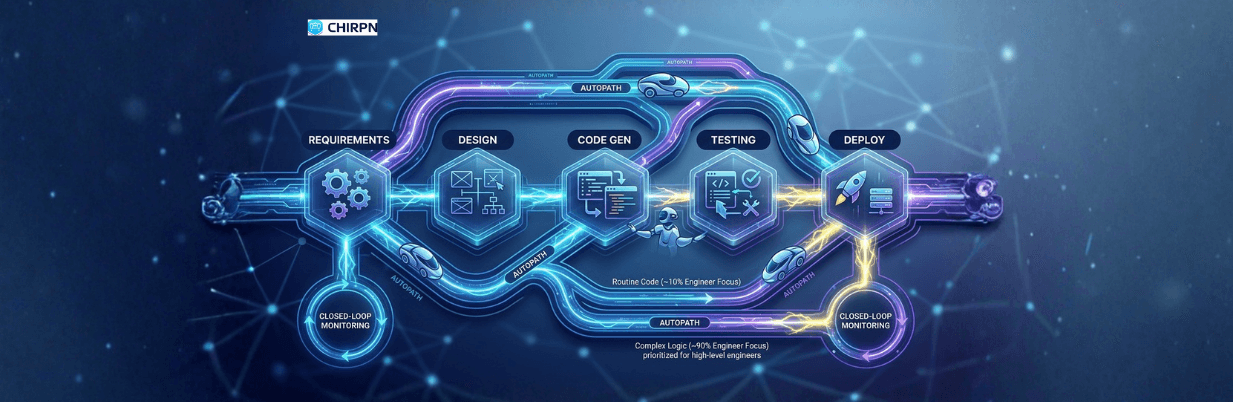
Chirpn's core framework, AutoPATH, employs AI to automate commodity code in software development - authentication code, standard API connectors, create, read, update, and delete (CRUD) code, test code, and infrastructure-as-code (IaC) code. Chirpn's published process estimates commodity code accounts for 60-70% of development costs, without adding value. AutoPATH returns that investment to the business and frees up senior engineering talent to focus on value-add business logic and AI algorithms.

This is not prompt engineering in disguise. AutoPATH spans the entire SDLC: from requirements analysis (where AI tools detect scope creep and inconsistencies early on) to code generation, automated quality assurance and deployment. This results in the Chirpn case studies' delivery of complex product prototypes in six weeks and product MVPs in 90 days.

AutoCAR and Agentic AI Systems

AutoPATH is added to AutoCAR, Chirpn's approach to delivering Agentic AI systems: software agents that serve as "digital employees" within a product, completing multi-step workflows without human intervention at each step. For enterprises, this translates into the deployment of AI agents for intake, triage, enrichment, and escalation of customer tickets and operations, as well as data pipelines. Chirpn teams identify two architectures that are often confused: MLOps (for structured data prediction - fraud detection, churn modelling) and LLMOps (for gen AI and agentic workflows). Being clear early on this architecture avoids costly rework.

Rapid Launch, Capacity PODs and BOT

Chirpn's delivery is suitable for three types of buyers:

Rapid Launch is Chirpn's fast-tracked delivery model, which uses the AutoPATH platform. It's for founders and product leaders who want a product to market before the cash runs out. The approach identifies the "steel thread" - the one workflow that delivers user value - and starts with that.

Capacity PODs address the hiring issue that derails AI projects. Instead of a client having to source and assimilate a separate LLM architect, data scientist and Python back-end engineer, Chirpn provides an engineering unit, ready to integrate with a client's workflow. Fixed costs become variable costs - a structural plus for firms dealing with investors.

Build Operate Transfer (BOT) offers enterprises a safer approach to offshore AI. Chirpn hires and operates the team, then transfers the team when delivery processes are established and client confidence is high. BOT offers a pathway for Australian and US enterprises to access India's AI talent pool without the typical risks of offshoring.

Delivery Across Australia, US and India

The Chirpn model brings an operational benefit: overlap with Australian clients during the day, same-day communication with US founders, and engineering excellence in India. For clients in highly regulated sectors, this approach offers redundancy and data residency.

For a deeper look at how Chirpn evaluates whether your project needs a generative AI approach or a traditional ML architecture, read: Why Startups Prefer AI-Driven Product Development Companies

Key Capabilities:

  • AI-orchestrated SDLC via AutoPATH (autonomous coding, AI-driven test automation, IaC)
  • Agentic AI development via AutoCAR (multi-step autonomous agents, LLMOps)
  • Retrieval-Augmented Generation (RAG) for enterprise knowledge management
  • FastTrack: MVP in ~90 days
  • AI engineering PODs: pre-tested units of AI engineering capacity
  • Build Operate Transfer (BOT) offshore AI team scale-up
  • Vertex AI / AgentSpace for Google Cloud clients

Best for: Startups running out of time who need an AI product ASAP; mid-market SaaS businesses seeking to add intelligence to their products; enterprise teams looking to establish offshore AI development with governance controls.

4. Haptik - Conversational AI at Enterprise Scale


 Haptik develops enterprise conversational AI solutions that automate customer support, lead generation, and transactions at scale for chat and voice channels.

Haptik has been acquired by Reliance Industries in 2019 and has handled more than 4 billion conversations to date. AI assistants are deployed on WhatsApp, chat on websites, chat within apps, and interactive voice response (IVR) systems - and employs NLP models based on multilingual Indian language data. Haptik powers conversational solutions for enterprise clients in telecom, Banking, Financial Services and Insurance (BFSI) and e-commerce to automate first line customer conversations and reduce the number of agents needed by 40-70% in case studies.

Key Capabilities:

  • Natural Language Processing (NLP) chatbots for support automation
  • Multilingual (12+) Indian language voice AI
  • Agent co-pilots for live chat

Best for: Companies with high-traffic customer interaction channels, needing conversational automation in Hindi, Tamil, Marathi, and other Indian languages - not just English.

5. Mad Street Den (Vue.ai) - Computer Vision for Retail


Mad Street Den's Vue.ai platform applies computer vision and deep learning to retail and e-commerce — automating product tagging, visual search, personalisation, and catalogue management at scale.

Chennai-based Mad Street Den built Vue.ai to solve a specific, expensive problem: fashion and retail brands spending thousands of hours manually tagging product images and building recommendation logic that goes stale. Vue.ai's models handle product attribution, outfit recommendation, and visual similarity search — trained on fashion and apparel datasets that general-purpose vision models handle poorly. The platform processes millions of SKUs for global e-commerce clients including some of the largest fashion marketplaces in Asia and North America.

Key Capabilities:

  • AI-powered product tagging and catalogue automation
  • Visual search (find similar products from an uploaded image)
  • Personalisation engines for e-commerce recommendation

Best for: Fashion, retail, and e-commerce brands managing large product catalogues who need to reduce manual tagging costs and improve recommendation relevance.

6. Arya.ai - Regulated AI for BFSI

Arya AI offers a platform for deploying AI models that is compliant for use by banks, insurers and fintech in the Indian financial regulatory environment.

BFSI AI needs explainability, not accuracy. Arya.ai does just that: it provides a platform with governance tools that enable compliance specialists to examine model reasoning, audit model decisions, and comply with RBI and IRDAI documentation requirements. It is used by clients to drive credit underwriting decisions, detect fraud, automate claims processing and for KYC/AML workflows.

Key Capabilities:

  • Interpretable AI for credit underwriting and lending
  • Machine learning for fraud detection in transactional banking
  • Documentation-compliant deployment of ML with audit trails

Best for: Indian banks, NBFCs, insurance companies and fintech startups working under the supervision of the Reserve Bank of India (RBI) or Securities and Exchange Board of India (SEBI) that require explainable AI solutions for regulatory scrutiny.

7. Locus - AI for Logistics and Last-Mile Delivery


Locus employs artificial intelligence and operations research to find the optimal routes, dispatch orders and manage warehouses, cutting the cost of last-mile deliveries by 10-20% for e-commerce, FMCG and retail companies.

Locus is a blend of machine learning and operations research. Its dispatch and route optimisation module optimises thousands of delivery orders in real time, taking into account the vehicle capacity, driver shift timings, traffic congestion, and SLA windows. Locus has helped brands like Unilever, Nestle and Zomato to optimise fleet. It has presence in India, Southeast Asia and the US.

Key Capabilities:

  • Optimised routes for last-mile and middle-mile delivery
  • Automated dispatch and re-optimisation
  • Load planning and warehouse slotting AI

Best for: E-commerce, FMCG distributors and 3PL companies with delivery operations in multiple geographies with complex SLAs.

8. SigTuple - AI in Medical Diagnostics

SigTuple creates AI-based diagnostic systems to use computer vision and machine learning to analyze blood, urine and sputum - to provide laboratory-quality diagnostics in environments where there are no trained pathologists.

The flagship product, Manthana, by SigTuple, digitises physical lab samples with smart microscopes and process images with deep learning models that are trained on millions of pathology slides. The technology fills a structural void in the Indian healthcare system: lack of trained pathologists, especially beyond Tier 1 cities. The devices of SigTuple have been implemented in diagnostic labs, blood banks, and hospital networks, with model accuracy that matches trained human readers on controlled benchmarks, providing blood cell counts, malaria detection, and urine analysis results.

Key Capabilities:

  • Complete blood count (CBC) analysis using AI.
  • Detection of malaria and tuberculosis through smart microscopy.
  • Computer vision urine sediment analysis.

Best in: Diagnostic labs, hospital networks, and healthcare NGOs implement diagnostic capacity in geographies with a dearth of pathologists.

9. Uniphore - Conversational Intelligence for Contact Centres

Uniphore is a unicorn level AI development company in India that uses conversational intelligence, voice biometrics and agent-assist AI to contact centre and sales processes - minimizing handle time and enhancing customer outcomes at scale.

Uniphore platform takes real time call analysis of the customer, relevant articles in the knowledge base are surfaced to the agent, customer sentiment is detected, compliance risk during a financial conversation is flagged, and post-call summaries are automated. Callers are authenticated by voice biometric system without a PIN or password. The business has attracted more than 600 million dollars of capital and functions in North America, Europe, Asia-Pacific, and the Middle East - becoming one of the most globally-scaled AI comapanies in India.

Key Capabilities:

  • Contact centre operations agent-assist (in real time).
  • Voice authenticated caller authentication.
  • Automated quality scoring and post-call analytics.

Best use: Large contact centre operations running within enterprises that need to enhance first-call resolution, decrease average handle time, and automate compliance monitoring.

10. Ksolves - AI/ML Services and Enterprise IT Transformation

Ksolves is an IT services firm listed on both BSE and NSE that offers AI/ML development services, generative AI integration services, and enterprise platform services in healthcare, fintech, logistics and retail.

Ksolves is an IT services delivery firm with more than 12 years of experience, and the Bombay Stock Exchange and the National Stock Exchange listing, which is an indicator of financial transparency, that enterprise procurement teams appreciate. Its AI usage includes generative AI implementation (OpenAI and open-source LLM), chatbot creation powered by NLP, fraud detection, and predictive analytics. The company also develops on Odoo and Salesforce to serve customers who require AI to be overlaid on an existing ERP or CRM system.

Key Capabilities:

  • Integration with OpenAI and open-source LLM models Generative AI.
  • Customer support automation chatbots based on NLP.
  • Sales, financial, and logistics predictive analytics.
  • Artificial Intelligence fraud detectors.

Best: Mid-market businesses in India requiring AI/ML services overlaid onto already deployed Odoo or Salesforce applications or those requiring a publicly traded, audited delivery partner.

How to Find the Right AI Company in India to do your project?

Select according to your criteria of the selection to the risk profile, time frame, and technical requirements of your project. Assess vendors based on four criteria: proprietary methodology, industry-specific delivery history, post-implementation services and governance preparedness. Ask customers of your industry, rather than its neighbors, to provide case studies.

The following is a real-world assessment plan:

In the case of startups and scale-ups: Time and budget efficiency are the most important. Find organizations that have faster delivery processes (not merely agile), ready-to-use AI infrastructure that minimizes commodity code bloat, and loosely-structured engagement designs such as PODs or sprint contracts. The Rapid Launch model of Chirpn and the Capacity PODs are specifically designed to cater to this kind of buyer. 

Read more: Is an AI Development Company the Future Your Startup Needs?

In the case of mid-market enterprises: Scalability and governance are more important. You must have a vendor who demonstrates how AI is monitored, retrained, and governed after go-live and not only constructed and delivered. Test the ability of vendors to differentiate MLOps and LLMOps, as confusing the two causes scale-breaking architecture choices.

Regulated industries (BFSI, healthcare): The ability to explain and audit trail capabilities are non-negotiable. Even model decisions that regulators would not be able to interrogate cannot pass compliance reviews no matter how well they predict.

In the case of Australian and US based businesses outsourcing to India: Check time zone overlap, communication standards and offshore governance structure by the vendor. With the Build Operate Transfer model - where the vendor constructs the team, manages it and transfers ownership, offshore risk is minimized as compared to a regular outsourcing arrangement.

Read more: Choosing the Right AI Development Company for Long-Term Growth

What Is the Current State of AI Development in India?

The AI development industry in India is shifting towards production deployment. It has 600,000+ AI practitioners, provides 16 per cent of the global talent in AI, and has the second-largest collection of publicly developed generative AI developers on GitHub. The IndiaAI Mission is a government investment that is providing compute infrastructure and policy support.

IBM data cited in several 20252026 research collections reports that 59% of enterprises of the scale were already using AI in India in 2025, and 74% of the first movers were increasing their investment faster in the last 24 months. 

The two most obvious barriers to scale: scarce AI expertise and the complexity of applying AI to industrial processes - both of which can be dealt with directly by specialist AI development companies.

The generative AI market in India is expected to hit a total of $8.3 billion by the year 2030, with Bengaluru, Hyderabad, Mumbai, and Pune being the major delivery and innovation hubs. This all is a sign that India is shaping the future of AI development.

Share:
Yagya Batra

Yagya Batra

Growth Manager, Marketing, Partnerships

Related Content